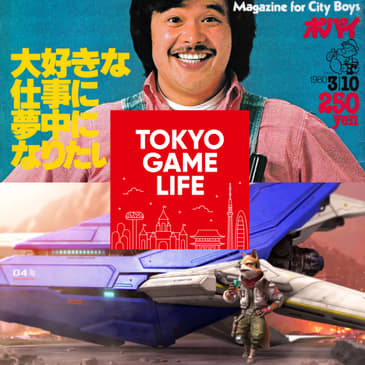
Writer and podcaster Drew Mackie is here to chat about the unknown origins of Mario! We explore everything you THINK you know about Mario, why lore is inconsistent between Japan and the west, and if they should bring back Mr. Video. Plus, I tell you if Star Fox is a perfect remake or not!
Follow our guest!
Mario 101: For Super Players: https://www.thrillingtalesofoldvideogames.com/blog/mario-101-history
Gayest Episode Ever Podcast: https://www.gayestepisodeever.com/
BlueSky: https://bsky.app/profile/drewgmackie.bsky.social
Need more podcasts? Check out Nintendo Dads: https://www.nintendodads.org/
(0:00) - Intro
Feature
(0:52) - The Unknown Origins of Mario w/ Drew Mackie
Games
(28:03) - Star Fox
News
(42:26) - Animal Crossing x Baskin Robbins
Social media:
Bluesky: https://bsky.app/profile/tokyogamelife.bsky.social
Twitter: https://twitter.com/TokyoGameLife
YouTube: https://www.youtube.com/@tokyogamelife
Instagram: https://www.instagram.com/tokyogamelife/
Threads: https://www.threads.net/@tokyogamelife
Website: https://tokyogamelife.com/
Like and subscribe on your favorite podcast app!
[00:00:07] Welcome to Tokyo Game Life, a Tokyo-based video game podcast focusing on Nintendo and gaming culture in Japan's capital. Your host Mono here to bring you a slice of gaming life from Tokyo. Writer and podcaster Drew Mackie is here to chat about the unknown origins of Mario as we explore his incredibly deep series of articles on the early days of Super Mario. We dig into the contradictory origins of gaming's most famous character, the weird lore discrepancies between Japan and the West, mysteries that still linger today, and more.
[00:00:37] Plus, in the game section, I look at Star Fox's long-awaited return. Let's get into the feature on the unknown origins of Mario with Drew Mackie. Today's feature is about the origins of Mario. You might think you know his history, but we're going to dive into all the misconceptions, contradictions, and inconsistent lore between America and Japan. Joining me to chat all about it is a special guest. So guest, please introduce yourself.
[00:01:07] Hi, my name is Drew Mackie, and I am a writer and journalist who apparently took on a big 40,000-word writing project about Mario for some reason. Thank you so much for joining me. I'm sure a lot of my listeners saw this in their podcast feed and thought, the origins of Mario, what are you talking about? But this subject was inspired by your excellent series of articles on your website, Thrilling Tales of Old Video Games, titled Mario 101 for Super Players, which is a detailed breakdown
[00:01:33] of over 100, I would say, misconceptions or urban legends about Mario. And you thoroughly break down things like what was really Mario's original name, if there are female toads, the biblical origins of dry bones, and many other interesting facts. So before we dive into them, what inspired you to write these articles? So I have, for the last eight years, been mostly a podcaster. But a few years ago, I started this video game history project where I wanted to be able to
[00:02:01] write about video game subjects and not have to explain very much. I'm writing for an audience who knows who Mario is, for example. And that was just a way for me to take some of the stuff that's been floating in my head for decades and put it in as polished a way as I possibly can. Because writing is a very different process than making a podcast, as you know. Because podcasts, you're just speaking off the fly. But when you write, you can edit and make sure that you're saying exactly what you want to say,
[00:02:27] which is not a luxury that we people who talk on mics always get, you know? Hmm. I just started writing these things. And there's a bunch of smaller Mario stories that maybe didn't make sense. I didn't think made sense as standalone articles. And for my 100th post on the site, I was going to do something about 100 facts about Mario, then it became the 101st. And then I just got busy with podcast stuff and got pushed back to the point where the 101 doesn't really mean... There's not any real reason why I picked that random number.
[00:02:56] It was just a cap where I was going to write this many short stories, items about Mario's history. And that would be a way for me to say, I'm done now. I'm not going to write anymore. I probably will write some more. And it went up on the site last month. And it's been really interesting seeing how people engage with this weird stuff that I decided to collect together in a way that I'm not sure anyone else has ever done before. Now, we can't touch on all 101 facts in our limited time. So yes, read the articles, listeners. And I've linked it in the podcast description.
[00:03:25] But we're going to get into a lot of my favorite things, especially the contradictory lore between the US and Japan and how all these disparate elements inspire each other and eventually congealed. But let's start at the top. Mario's name. I think most of us believe that he was named after Nintendo of America's landlord, Mario Segale. And previously that he was also known as Jumpman before he was christened Mario. But this is only part of the story. Can you walk us through how Mario got his name and all the other names he was called in his
[00:03:55] early days? Mario was the character that was created by Shigeru Miyamoto and was supposed to be the go-to star in any sort of video game that Nintendo made. That was the plan initially. But before he was named Mario, he was called Osan, which I think you know means old guy, right? Yeah. Like old man. And Osan didn't last very long. Then Mr. Video or Mr. Video Game were both in contention for a while. And I think Miyamoto really liked this name, but he admits now that this was not something
[00:04:25] that would have resulted in a famous video game mascot. And when Donkey Kong was released in Japan, Mario didn't have a name that was stated in game. He was just the player. And when that game shipped to North America, he was called both Jumpman and Mario both, which is very strange because I think a lot of people assume that Jumpman was the Japanese name and Mario was the name that he got attached to in North America. That's not really the case. Both of those names came from the original North American release of Donkey Kong.
[00:04:55] Jumpman was the first one. And then at some point, people working for Nintendo of America realized that this character apparently looked like their landlord and attached the name that way. But even that is very confusing because the various iterations of the story about how Mario Segale became the namesake for Mario are different and contradictory. And it results in a way that I couldn't make sense of on my own. Since the post has gone up, Chris Culler, who is a much more renowned video game historian
[00:05:24] and writer, has pointed out that one of the reasons that there are so many different versions of the Mario Segale story is that the person that usually tells them is Shigeru Miyamoto, who never really worked for Nintendo of America. He was in Kyoto. And he therefore was only hearing the story about how Mario became this character's name secondhand. But he is treated as the go-to guy for all things about Nintendo lore. And this is a really interesting instance of Japan and outside Japan playing off each other
[00:05:52] in a way that creates confusion, contradiction that I realize now can't actually be explained away through what Chris Culler told me. But you still have a variety of these stories lying around that do seem to conflict with each other. And just from a journalism standpoint, if you're looking at what's in the written record, it's quite confusing. And maybe surprising to a lot of people that there's not just one single way to tell that story. Yeah, I do like the name Mr. Video, but it sounds very 80s. It does.
[00:06:21] The thing I love about Mario is that he would not be created today. Nobody would make a portly, let's say, Italian stereotype and give him a rather common name. And then that's the face of your franchise. And he jumps and eats mushrooms. That's not something a boardroom is coming up with. And yeah, we give a lot of credit to Miyamoto, but many of the iconic elements we associate with him, like his name, came from a variety of sources. Especially a lot of the lore originated in America.
[00:06:47] And why do you think there's such a gap in terms of establishing a canon for Mario early on? I think video game culture was in a place. Well, Donkey Kong was the first game, for example, that had narrative elements because you get the cut scenes basically showing that the big ape is stealing the girl and Mario is chasing after her. And that was radical at the time. And I guess they thought that was an upgrade enough. They didn't need to flesh out the story on the back end with the literature that's accompanying the release of this arcade game.
[00:07:16] And as a result, these things just existed on their own. Or in the case of the girl, she was just called Lady. And that is something that might have landed with Japanese audiences a lot differently than they landed with American audiences. Do you think it's a little surprising that Japan adopted a lot of Western-created elements of Mario and canonized them? I feel like that doesn't happen too often. For example, the names of the four big bosses from Street Fighter 2 are still completely different in Japan and the West. Right. So it wasn't a reciprocal change.
[00:07:46] It's not like Capcom of Japan moved to incorporate this Western thing to avoid a lawsuit from Mike Tyson, which is what that was about. I think it is probably not surprising when you think about the United States and Japan being a constant cultural exchange and sending things back and forth and playing off each other and tweaking each other's inventions in interesting ways. That's something that's been happening for much longer than video games have even existed. But I do think it would be surprising for people who are very into video games to find
[00:08:14] out that the Japanese side of Nintendo was not the end-all be-all for establishing some of this really foundational lore. And that a bunch of Americans who were working in first New York and then Seattle actually had a hand in that too. And that makes me like it. I love, obviously, I love Japanese exports. But the idea that the Mario story is a little bit more international makes me a little bit more because it makes it seem like it really was a group effort. And sometimes it does get confusing about, oh, what is the real lore or what has not been adopted?
[00:08:43] Of course, like when everyone suddenly discovered T. Yoshisore Munchakupas, I believe, was his name. People were like, yeah, this is his official 100% really true name. Yeah, it's interesting to see that some canon was really adopted. Some canon was kind of ignored. And then, oh, what do you decide is canon and what is not canon? I think it's fascinating. And I'm someone who likes long-running IP, like with comic books, American comic books.
[00:09:09] There are some stories that are part of a character's hardcore baked-in history. And there's some stories that just get excluded for one reason or another. And I think it's interesting that it's not always necessarily the company that's making those decisions. Sometimes it can be the audience. I think in the case of T. Yoshisore Munchakupas, which is something that never happened in Japan, was only a North American coinage. Americans who saw that said, absolutely not. We are not going to do that. And going back to Miyamoto a little bit, one thing I learned from reading your articles
[00:09:37] is that Miyamoto truly just does not remember how many important elements of Mario as a character came to be. For example, Miyamoto both said that he became Italian because he was designed with a mustache and also that he was always intended to be Italian. So my question to you, is Miyamoto okay? And why are there so many contradictions regarding the origins of Mario with Miyamoto? I think he's in his 70s now. And he's been in this job for a very long time and he's had his hand in a lot of franchises.
[00:10:06] And on the boat, Mario is the most famous of the franchises. Not every little bit of background lore is a precious baby that he holds in his heart forever. And if I've been podcasting for a long time, and I'm sure I've contradicted myself on Mike more than once, where I said I remembered something one way, then I remembered it another way. The difference is that no one cares about me. People care about Shigeru Miyamoto a great deal because he is the creator or thought of as the creator of a lot of things that people care a lot about.
[00:10:34] And they want to put all the necessary weight on everything he says, but he's only human and his memory is going to reinvent something once or twice. And it's not a huge deal unless you're me and you're making a list of all the times he did it. He really does focus on the gameplay first. And I remember even like a recent anecdote, they asked him, of course, the Switch's codename was NX once upon a time. And then they asked Miyamoto, oh, what did NX mean? What does it stand for? And his answer was, oh, I don't know, maybe next or something.
[00:11:04] So like, of course, that's not his priority. It's like these types of like minor details. He is like a big picture guy. And one of my favorite facts that you delve into is the naming of Bowser, aka Koopa in Japan. And this is something I never really thought of, but no one knows why he's called Bowser. Nobody can point to somebody and say, this is where the name came from and why. Were you surprised to learn that in your research that there really aren't a lot of definitive answers for some of the most iconic elements of the series? Yeah.
[00:11:34] And I say that as someone who has reached out to the better part of people who work for Nintendo of America back in the day. I will find one person and be like, I'm going to find this piece of information. Can you possibly tell me who might have come up with it? And they'll be like, oh, I don't know, because this was just a job for some of them. It's not even necessarily a job that they cared about as much as we care about it now. And these things are just lost forever. And no one has been able to figure out exactly who named Bowser, unfortunately.
[00:12:02] And the fact of the matter is, it might have been someone who just tossed it off like it was nothing and never thought about it again, and might even be surprised to learn that this name is still in use today. And people like me are getting all worried that we're never going to find out the secret for where it comes from. But yeah, so surprised. But it is humbling to realize that these people worked for Nintendo for three years, four years, and they went on to something else. And their dream job might have been something else. And they don't think about Nintendo as much as I do. Yeah.
[00:12:30] And it also is funny that Japan is like, okay, he can be called Bowser in America. We don't really care. It is interesting that they really didn't centralize all the power in Japan at this time. They were much more separated than you would expect. And even today, that still kind of happens. Character names will be different from Japan and English. But there's been definitely a larger concentrated effort to kind of standardize things across all regions. So what do you think is maybe the biggest misconception regarding Mario? Something that everyone believes, but it's completely untrue or half true at best.
[00:13:00] I can say that regarding Bowser, and this might be something that people that listen to this podcast in particular might have in the back of their heads. There is this idea that the Kupa was influenced by the Kappa of Japanese folklore. And that seems like a really obvious yes, because Kappa are often localized as turtles when you're taking a Japanese thing and presenting it for a non-Japanese audience. And they look enough like turtles that people would just be like, yeah, I guess that's what it is. Yeah. That is not the case at all. The name Kupa comes from a Korean food dish. It's the Japanese version of that Korean name.
[00:13:29] And it is just a coincidence that it's so close to Kappa. And in America especially, we tend to use Koopa for anything that is a turtle in this series. Like the grunt of Bowser's army is the Koopa Troopa, which is an amazing coinage. Obviously, they have to keep that forever because someone figured that out. But in Japan, Bowser's name doesn't extend to these lowly characters. It's called a Noko Noko. And there's no nominal connection to the big bad.
[00:13:56] And it's just a weird branding exercise that works very differently in the United States. And I think anyone who knows a little bit about Japanese mythology and folklore might be like, obviously, these things are based on the Kappa. He's like, yeah, that's a really good guess. But sometimes your best guess about something is incorrect. Yeah. Speaking of Noko Noko, one thing that really surprised me is that, yeah, for one, I had no idea that the Japanese names for a lot of the enemies, like Noko Noko or Patapata or Puku Puku, are really from Takashi Tezuka calling himself Ten-Ten as a nickname.
[00:14:25] This onomatopoeic naming scheme, it really just comes from Tezuka. And so a lot of these enemies are just because of this one quirk that Takashi Tezuka has. But now there's these huge internationally known characters. What do you think is maybe the most shocking fact that you touch on in your articles? I would say there is a reasonable theory that Pauline, who's the girl from Donkey Kong, and is maybe the oldest character and the first character to appear in more than one game.
[00:14:54] And this is interesting for a few reasons, because she was gone for years. And she wasn't a character that you were seeing in Mario Kart until very recently. And now there's been this whole push of having the lady in the red dress be a big part of the series. And some people are excited about that. She might have had the entire series ganked from her by Mario. And that is especially interesting, because the story everyone knows about Donkey Kong is that it was originally going to be a Popeye game.
[00:15:21] And Mario was Popeye, Pauline was Olive Oil, and the barrel-throwing monkey was Pluto. And there's a weird parallel. Like, Popeye comes up so much in Mario history, even when you don't expect it to. And one of the weird parallels there is that Olive Oil was originally the star of the comic strip. It was Olive Oil's comic strip where she was the main character until Popeye showed up, and he stole the comic strip from her. It was a new character that readers responded to more, and she became a secondary character compared to Popeye.
[00:15:47] And that's exactly what happened to Pauline, who was going to be showing up in other games early on. And not only did Mario take over, but Luigi took her place as the player too. Before Luigi came along, Pauline was the player too you could play as. And it was a very briefly held position. But there's something telling and something about a woman's place in media that is, I think, interesting that basically she had to claw her way back up from having lost everything to a male character.
[00:16:17] Yeah, that is interesting because we think of, oh, Urkel. Urkel was like a side character in Family Matters, and then he became the main thing. This happened many times before Urkel. So maybe Urkel is actually Popeye. And Mario also kind of did it to Donkey Kong a little bit. It was his name. So there's a long tradition of, maybe we should call it being Popeye instead of being Urkel. I agree. He's the oldest one I can think of. And speaking of Popeye, one of the most mind-blowing things that I saw in your article was this cover
[00:16:46] of a Japanese magazine called Popeye, which is still around today. And there's a man that looks pretty much exactly like Mario. So is there anything to this? Or is this just the greatest coincidence of all time? This is a question I come to a lot in culture criticism, is that sometimes you just hit something that doesn't make sense and shouldn't exist. And it's like finding, sometimes they're called out-of-place artifacts, if you're talking about in the archaeological sense of something that should not have been buried in the ground, but looks like technology that hadn't been invented yet.
[00:17:15] And this is one where we have an official story for how Mario got us look, and that's that wearing what amounts to overalls with a different color shirt underneath allowed them to show him moving his arms. And wearing a mustache made it so they didn't have to animate a mouth. There's a lot of technical pixel-related reasons why Mario looks the way he does. And yet there's this 1980 issue of Popeye magazine featuring a very Mario-esque character, and there is no explanation for it.
[00:17:40] It is entirely possible that Shigeru Miyamoto saw it and decided that the look of this guy actually solved a lot of the problems they were trying to get around with the character they were calling Mr. Video at the time. But no one's ever asked him. No one's ever showed it to him. I would ask him. It's probably in my top 10 questions I'd ask him if I ever got the opportunity. But I think someone else probably is going to talk to him before I do. Yeah, we have to look at the Popeye subscriptions around 1980 Kyoto and see if Miyamoto's name
[00:18:09] pops up there or not. But it is at least, if it's a total coincidence, it is a very fun coincidence. Maybe things are destined to be. Mario was destined to be in our lives. Since a lot of the facts you talk about relate to character names, do you have a favorite Japanese name for one of the Mario characters? I love that the Goombas in Japan are Kuribo. Kuribo, which is referencing the wrong produce item. Goombas are obviously walking mushrooms, but the backstory with the Kuribo name is that
[00:18:36] someone who was working on the game didn't know just looking at the pixels and thought they were supposed to be chestnuts. And that name stuck in Japan, regardless of the fact that everyone realized, no, it's supposed to be a shistake. And it was never corrected. And it's just been baked into the mythology, but only on the Japan side, unfortunately. Yeah. And then there is a real fun connection between all the different Goomba variations and also the Japanese name. Because there's Goomba and then there's Galumba from Super Mario World. And in Japanese, it's Kuribo and Kuribon.
[00:19:04] And there's also Goombrat, which is supposed to be like a persimmon, like a walking persimmon. And he's called Kakibo in Japanese, which is like persimmon and Goomba together. I don't think I put the persimmon one in here. I think that's something I missed in my Goomba produce section that I should pop back in. Because I have the one that's supposed to be, I think the Kuribon was literally designed to look more like a chestnut, unless I'm mistaken. Yes. It is funny that, oh, the name from Goomba, that's a mushroom, has chestnut.
[00:19:33] But then they made a chestnut Goomba. And they also made a persimmon Goomba called Goombrat in English. And there's a smaller Goombrat called Goombud. So please do not get these mixed up, all these different names. What is Goombud in Japanese? Kakibon. Okay, so it's a very similar naming scheme. So it gets very confusing. If you want to add a 102 fact, I highly recommend it be related to all the confusion between the Goomba and Goomba and Goombud and all these different things. I am going to do an addition.
[00:20:02] I promised myself I would take the month of June off from Mario and write about other subjects when I had the time. But there was so much that I caught from this that will go in there eventually. So what character did you learn the most about when writing the articles? We touched on her before, but I really enjoyed reading all the Pauline-related factoids, like the theory you talked about is that, oh, she is maybe before Mario. And she was also the default player too before Luigi. So I want to say Birdo is the one that I've learned the most about in doing this project. But that's because I did a very long post, which is an entire history of the way that
[00:20:31] this character has been gendered in the West and in Japan, which is complicated and interesting and sometimes not always the best, but never boring. And some of that did make it into the Mario 101. And I would like to think that I'm in the world's top five Birdo experts at this point. As far as for this one project, it probably has to be Pauline. Although actually, no, I'm going to take a step back and I'm going to talk about Stanley
[00:20:58] the Bugman, who is the hero of Donkey Kong 3, who got screwed pretty royally when it comes to video game legacies. He did not get another game after Donkey Kong 3. And it makes it seem like he's a one-off. And that is not true. He actually was being put forward by Nintendo as a new hero that they thought humans would like. It just did not work out. Humans said no to that. And I think it's number 91 on my list is the sad story of how Stanley the Bugman lost his chance at video game fame. Yeah, even as a huge Nintendo fan, and I talk to a lot of, I mean, a lot of Nintendo fan
[00:21:27] circles, Stanley is really, he's either at least ignored at best or disliked at worst. I don't see a lot of love for Stanley the Bugman. But if Nintendo wants to do like a Pauline-style comeback, he's at least a worthy candidate in my mind. Are there any facts that you cut out or stuff you wanted to verify but just couldn't, and then you decided not to include it? I know there's something that I couldn't verify. That is all in a Google Doc that I can't open at the top of, I can't open now because it's too much of a mess.
[00:21:57] And looking at it, I'll just get lost in half form sentences and ideas that I just briefly jotted down. There are things that I was holding out for. I wanted to talk to someone who worked for Initiative of America and find out what the origin of Lakitu, who's the egg throwing Koopa who floats in a cloud. Yes. I wanted to find out what the origin of that was. And unfortunately, that is just going to have to wait for a later day. I reported on the mystery of it as its own item and was hoping that someone who worked at Nintendo would read it and be like, I can fill this in for you.
[00:22:26] Here's where that name came from. That did not happen. That has not happened yet, unfortunately. Although maybe they'll listen to this podcast and reach out to me about it. Are there any rumors or theories that you kind of wish were true? I really love the idea of Luigi being named for a Seattle area pizzeria that was called Mario & Luigi. And it just is such a neat, tidy name. And I would believe it if it were true. And that is the name that's often circulated around even when you're talking to official Nintendo people. But no one has ever been able to prove that there was a Mario & Luigi Italian eatery in
[00:22:55] the greater Seattle area ever. And it might just be, it's so weird thinking about where that story would have come from then. Did someone just make that up? Because that's a really weird thing to make up. And I have no explanation for why someone would do that aside from the joy of passing along bad info. Yeah, Luigi's name is also a little confusing about where it came from because maybe at one point it was said that, oh, it's based on Luigi, which is similar in Japanese.
[00:23:22] And then there's also, oh, Miyamoto said, oh, it was the second most popular Italian name. So I went with that. But does he have some sort of book or list of most popular Italian names in the 80s? So it's like, where did this name come from? Do you have any concrete idea about what could possibly be the biggest inspiration for Luigi's name? I think if I were Miyamoto, I would have told my assistant, I'm sure he had an assistant, hey, can you find out what the most popular Italian names are? And they probably, lacking internet resources at the time, they probably came up with something
[00:23:51] they said was that. And there was a five-letter one that looked good. And the similarity connection, I think, made it stand out to him. That's the reason he would have picked that over anything else. But it is interesting that he's mentioned in interviews that there's a rumor that it had to do with it being so close to the Japanese word for similar. And that's not it. But he's actually the one who created that rumor, at least in an early newspaper interview that you can find on the first page of my piece. Yeah, there was definitely a time in my life where I thought, oh, that's why he's called Luigi.
[00:24:20] And it was from the mouth of Miyamoto. But as your article sheds light on, things are not as clear as they should be. Are there any other franchises or series you'd like to do a big 101 fact breakdown in the future? Like Zelda, perhaps? Zelda, yes. I'm not. I don't have an encyclopedic knowledge of Zelda the way I do of Mario. But I think I could probably do it. And I've done some pieces about weird linguistic three lines with the Zelda series on my piece already, on my site already. And I know people would really respond to that.
[00:24:49] I think the one that would be the most interesting for me to do would just be a list of Final Fantasy character names and where those come from. Because I know Final Fantasy really well. And Final Fantasy is such a fascinating mishmash of world cultures and religions and mythologies that things crash together in very interesting ways. And the struggle of localization is that things get lost in the translation, literally. And sometimes there's interesting connections that people aren't aware of that I would like to bring to light with those games. And I think people get a kick out of that.
[00:25:18] So probably one of those two. Nice. All right. So that was a look at the origins of Mario. Drew, where can people find you? And where can people find the articles? The website is thrillingtalesofboldvideogames.com. The name is Mario 101. If you are looking at it relatively close to when this episode is going live, it's going to be on the top page. If you just Google Thrilling Tales of Video Games Mario 101, you'll also find it. I am on Blue Sky. People have questions. And please ask me questions because I like talking about this stuff, obviously. At Drew G.
[00:25:47] Mackie, M-A-C-K-I-E. And I also happen to have a podcast that I'm actually retiring this summer. It's been my go-to thing for the last eight years. It's called Gayest Episode Ever. And it's about gay episodes of old sitcoms. And if you would believe how many similar research muscles it goes into studying old TV and old video games, you might be surprised. Have you ever covered the Super Mario Bros. Super Show on your podcast? I didn't. I just did an episode of something about this. I can't remember what podcast it is.
[00:26:17] And I'm actually going to be covering it again in the near future. I wanted to do the episode of The Adventures of Super Mario Bros. 3 with Milli Vanilli. But a friend's podcast actually did that and talked about how weird it is. That episode aired right around the time that Milli Vanilli was crashing and burning. That, I think, is the one that's of the most cultural value. But you know what? Perhaps I should do a rewatch. Listeners, the links to everything are in the podcast description. So check it out. If you want to be a Mario otaku, if you want to um-actually people until the end of time,
[00:26:45] I really highly recommend you read these articles. They're really excellent. And I like to think of myself as a Mario fan. Not number one, but at least maybe top ten. But there are many things I learned from these articles. So let's just definitely check it out. They're in the podcast description. So, Drew Mackey, once again, thank you so much for joining me. Thank you for having me. Hey folks, Marty Estes here, one of the hosts of the Nintendo Dads podcast. Nintendo Dads is a weekly conversation about all things Nintendo with a dash of fatherhood
[00:27:14] sprinkled on top. We cover it all from news, rumors, speculation, what we've been playing, and even a little bit of parenting issues. We love Nintendo and hope you do too. And if that sounds like you, we'd love to have you give us a chance each week. We record live on Thursday nights at 830 Central, where you can watch along with us on Twitch, YouTube, X, TikTok, and Facebook.
[00:27:39] Or you can grab each episode in an audio version when it releases every Friday in your podcast service of choice. Also, be sure to check us out at our website, NintendoDads.org, for all the things I've mentioned, plus lots more content. Let's-a go! 2017. That's when the last Star Fox game came out, which was Star Fox 2.
[00:28:09] Yes, it counts. That was a new release. But now the franchise is back with Star Fox, which we will all be awkwardly calling Star Fox 2026 or Star Fox Switch 2 until the end of time. I mean, you can't give it a subtitle, Nintendo? Star Fox Reborn? That's totally fine. Even just Star Fox again. But it is indeed a remake of Star Fox 64 from Velen Studios, who Nintendo fans know from Mario Kart Live Home Circuit.
[00:28:36] The quote-unquote real-life Mario Kart in your home. I will say that Nintendo has a fantastic knack for finding interesting devs to work with. If you said, what studio should make the next Star Fox game, you might be thinking, uh, I don't know, Koi Tecmo? Maybe an indie studio that has a really good rail shooter? But no, Nintendo has indeed tasked a studio most people have probably never heard of. With bringing back Star Fox. And having completed a full hard route to run, some multiplayer, and some challenges, they
[00:29:05] did a pretty fantastic job in resuscitating the franchise. My history with Star Fox 64? I mean, when I first played it, the game instantly rocketed up to one of my favorites of all time. I loved it, played it over and over again. My mind was blown when I realized there was a brain Andross. To me, it is one of the best and most iconic Nintendo 64 games. It was an absolute technical marvel at the time, too. It was The Last of Us 2 or the GTA 6 of its day in terms of the graphical fidelity and
[00:29:34] the cinematic storytelling. Since then, though, it's clear Nintendo didn't really know what to do with the franchise. We got Star Fox Adventures, which is a glorified skin of another game, which I admittedly barely played, but that's not what I want from the series. Then Star Fox Assault from Namco, a game some people will say is actually pretty good, but no, it's not. There are 10 missions and six are on foot. Then we got Command on DS, which actually had some pretty interesting ideas and utilized the limitations of the hardware in some cool ways.
[00:30:04] But again, it's not what I would want from a Star Fox successor. Then 64 3D, which yes, another remake. Then Zero, which most agree with a blunder. Then 2, which is an awesome release on paper, but my dark secret is that I just cannot play the SNES Star Fox games for too long. The frame rate just kills me. So 64, that's my Star Fox. But when they suddenly announced that the first Star Fox game in a decade was yet another retelling
[00:30:31] of Star Fox 64, which was really just a reimagining of the first game, obviously I was a little bummed. I've probably gone through every single route in the original game. I've even cleared it at least once on NSO. It feels like the safest, blandest, most unambitious direction you could take the series. They essentially polished up a diamond. But when you get into the game and start playing, it's undeniable that the game looks sharp and is boosted by the slick gameplay and fantastic level design from the 64 title.
[00:30:59] I think it can be a little hard to pinpoint specifically why Star Fox 64 is so good. But to me, I do think there is a very smart balance in terms of the difficulty. It's an on-rail shooter, but it's not extremely hard like Space Harrier or even Sin and Punishment. But it's not exactly easy either when it comes to getting a high score or accomplishing some of the level-specific missions. It's got a flexible difficulty which lets anybody beat it, but there's enough there for the really hardcore to fiddle around with.
[00:31:25] It's a classic example of Nintendo aiming for a wide audience, but still having enough depth to make enthusiasts still pine for it decades later. And then you couple that with the sheer variety of levels in terms of their visual designs, their objectives. After doing a run, you will want to see what you've missed. And even once you've done every level at least once, you will have the urge to find the best route, to find one that's the biggest challenge or the most gameplay variety. Very much like a roguelite, it does trigger that one more run part of your brain.
[00:31:54] And I was wondering, if it was just a one-to-one recreation of Star Fox 64, will people just complete a single run in about an hour and then put it down forever? Whatever. That may still happen, but the game does a good job in encouraging you to play more by detailing the different routes and missions in a single stage and showing more clearly what you have and haven't accomplished yet. So there's more of a clearer checklist in what you can do in the campaign mode, something the original game really didn't have, and the long tease for the expert mode, which I'm sure hardcores will want to unlock. So what's new about the gameplay?
[00:32:23] Well, nothing. There's no new abilities or levels or anything like that. You can play this game with the N64 controller. It's not like they added something new to the ZR button that the N64 controller couldn't handle. Veterans like myself who have stages burned into their memories might be a little sad, but newcomers to the franchise won't care, and that's really who this game is for. This is Nintendo's attempt to elevate the franchise back into the upper echelon. Or at least middle echelon. Right now it's in no echelon.
[00:32:52] And like I said before, Nintendo went down the least risky route to do so, but it is an effective one. For Star Fox 64 fans like myself, there is still a tremendous amount of novelty in playing the game with the new visuals and art style. And also going back to why Star Fox 64 is so good, just all the levels have the juice. Every single stage has something unique about its gameplay. You're darting through an asteroid field or blowing up a train with a tank, or you're
[00:33:18] in a submarine in pitch black darkness, or having a big dogfight against the entire army, or managing your shield health as you fly on a star with fire dragons coming at you. No level is bad. No level is boring. But yeah, the aforementioned star level, aka solar, is kind of annoying, but I do think they made it easier in this version. Also, it is kind of funny how General Pepper is like, you've got to go to Sector X. This will strike a major blow in the Andross army. But then Star Fox is like, I don't know, man, there might be a monster on the sun.
[00:33:48] So let's go check that out. Did defeating that thing actually help the war effort at all? It seemed fairly harmless in the grand scheme of things. I'm trying to put myself in the shoes of somebody playing Star Fox for the first time ever, thanks to this game. And if they can wrap their head around the idea of playing the campaign multiple times and focusing on doing missions and score attacks as opposed to just seeing credits, Star Fox 64 feels so singular with this hodgepodge of weird inspirations, ranging from Japanese shrines to Independence Day. And all of that is backed up by really diverse and smooth gameplay.
[00:34:18] I might be out of the loop, but who is making on-rail shooters these days? Like what was the last really good one that got any sort of attention? Please tell me because I do want to play it. But in the meantime, I am satisfied with Star Fox. Okay, the visuals. Now, the character designs, still not convinced. If Velen gets another crack at the franchise, I do want them to try to mix it up a bit more. But the environments, the lighting, the ships, they feel believably Star Fox-y.
[00:34:44] It is impressive to see such detail on enemies that were really just a bunch of triangular polygons once upon a time. They do take some visual liberties with the game, like the background of Area 6 is more of a smoky yellow haze, similar to Venom, while in the original game, it was just a black space background. Some of the visual changes like this aren't going to sit well with anybody. I've even already seen people complain about the explosions compared to the N64 game. And for me, all the ships and machines look great, but Brain Andross, it just doesn't hit the same way the N64 version did.
[00:35:14] The arena doesn't look as good, and he's just way smaller. I know it may seem silly to say they ruined the battle arena for Brain Andross, but anytime you change any sort of notable visual element like this, you're flipping a coin regarding whether or not people will dig it. So get ready for this times a billion once the Ocarina of Time remake comes out. I will say that the visual indicator for the hit detection is not good at all, especially for bosses. In the original game, it would flash with a really chunky sound effect when you were landing hits on a weak point. But here, it's far less noticeable.
[00:35:45] There were times when I genuinely thought, wait, is this not how you defeat the boss? Because I had no idea if I was actually hitting the weak point or not. I do think this should be addressed in a patch. Just make that part flash red with a really noticeable sound effect when you hit the weak spot. And beyond the hit detection indicator, another thing that is absolutely better in the N64 game is the voice acting. I was extremely worried after watching some ads and previews, but once you're playing the game, well, they are really good, but they aren't noticeably bad either. It just kind of washes over you.
[00:36:13] But I do think Fox's voice actor is pretty good. But the original game had so many iconic lines that hit so hard because of the extremely over-the-top and expressive performances by the voice actors. I mean, it must just be the tone of the Switch 2 game, which is still lighthearted, but also does have an air of seriousness about it. I'm sure the voice actor for Andrew, for example, Googled what does this guy sound like? But the directors wanted to go down a different road as opposed to an imitation or a heightening. I also do think the decompression in the N64 game
[00:36:43] adds an unintended piece of atmosphere to the voice lines. It makes them feel like they are really coming over the communication lines in a chunky starship as opposed to it sounding crystal clear. But while we are on sound, the music though, great renditions of those classic tracks. You could put these songs into Smash. They are just that good. Quote-unquote Smash quality is pretty much the highest award you can give a soundtrack. And another major addition to this game is that there are more cutscenes and story elements in general.
[00:37:11] There is a nice intro at the start where you see James get betrayed by Pigma, and the Post-Mission interlude also has General Pepper checking in with the Star Fox team as they're aboard the Great Fox. Yes, a lot of them are. Here's everyone sitting around a table. But they do get creative with them sometimes. I like the scene where Fox just grabs an energy drink from his gamer fridge. The game also has a good sense of world building, almost in a Splatoon-esque way where it feels very lived in. You also have a better understanding of why you're going to each area and how it is affecting the overall war.
[00:37:40] And one thing that is new is that you can sometimes pick where you want to go. For example, in Corneria, if you fly under the arches, you do a secret boss battle, and then in the N64 game, you're shoved off to sector Y. But this time, even if you go under the arches, the game does let you go to Meteo instead if you want, and the team even talks about the advantages of picking one route over the other. This is great for multiple playthroughs where you are trying to pick a specific route, but still want some flexibility in terms of what you want to do in the level.
[00:38:08] I also think the cinematic cutscenes when you enter a level are really well done, and they want to make the team look as cool as possible, and the environments also look really wondrous. The story is indeed more fleshed out while playing, but the hollow viewer area basically contains an entire lore bible. Each character, enemy, ship, they have several paragraphs written about it, detailing info you never learn in the main game. Did you know that Andross was sentenced to death by a military tribunal? Or that James McCloud made Starfox because he was fed up with bureaucracy? Or what the attack carrier was used for before it went rogue?
[00:38:38] You even get more info on stuff like space dynamics. Maybe a lot of this is old news if you are really deep into the lore of Starfox, but it is great to see it laid out in an interesting way in an official capacity, as opposed to being a paragraph in the back of a Japan-only strategy guide. Now, while the main campaign may be old news, the challenge mode is one of the bigger additions. Here you can pick a level, but only after you've played it in the campaign, then do a series of challenges. Fortunately, you don't need to do them all in one go. These truly test your knowledge of the level's layout.
[00:39:08] For Corneria, some of the challenges are beating it in three minutes, so a liberal used up the boost feature, defeating all the construction robots, defeating the jet ski robots, blowing up every single part of the boss, and so forth. You can probably knock these out in maybe a few runs, but then it unlocks the expert challenges. And these things are not messing around. For Corneria, aka the easiest level, the expert challenges include getting 100 hits before taking damage. Or completing the archway secret before Falco does,
[00:39:36] which I didn't even know was technically possible. Or preventing all the buildings from being pushed over, another thing I didn't know was possible. And beating the Granga boss in 10 seconds. So if you're tired of playing the campaign over and over again, try to cut your teeth on these challenges, because they would test even the most diehard of Star Fox 64 players. You could definitely spend more time here than multiple run-throughs in the campaign. And the campaign and challenges unlock a lot of customization items for the multiplayer mode, which is another big addition. The original game had multiplayer, which was really just split-screen dogfighting.
[00:40:06] And I still contend that this is some of the most underrated multiplayer on the N64. Sadly, as a kid, nobody really wanted to play it. I mean, when you've got Smash, No Mercy, Mario Party, you aren't picking Star Fox 64 during the sleepover. I've only done a few rounds, and I'd follow this under quote-unquote good enough. It's probably way more fun if everyone had their cameras on with their avatars. But if you jump in solo, you just have a big map you fly around in, and you try to rack up points by defeating enemies or doing the level's objective, like carrying a big tube to a goal
[00:40:35] or controlling a central point. The scoring system is pretty interesting in that everyone can kind of focus on multiple things and still manage to win, as opposed to just everyone pushing for this one objective. I don't know how active this multiplayer mode is going to be in a month or two, but you can play with bots. So if you just want to keep unlocking little icon elements for your name tag, you can do so. And there are a lot of new power-ups in the multiplayer mode, like a teleport ability and special shields. So maybe this is a taste of what we could see in a future Star Fox game. So although it's not a revolutionary title for the franchise, it's still a good one.
[00:41:05] And we haven't had a good Star Fox game in quite a while. I mean, Star Fox 64, it really is a bona fide classic. It doesn't feel dated at all. I can easily see newbies picking up this game and becoming a Star Fox fan, something I doubt happened a lot when Star Fox Zero came out. And I'm just glad the franchise is back. I do think another major Star Fox project is already in development now. Whether it be a completely new type of game or a sequel to this one, I'm not sure, but I doubt Star Fox ends here. I mean, make the Star Fox roguelite.
[00:41:34] You upgrade your ship and team members during a run. You have a pool of levels with elements that change each run. So even the same level doesn't feel the same if you play it more than once. The game already kind of has a roguelite structure to it. So just take it to the next step. How did Donkey Kong get a roguelike before Star Fox? How did that happen? But Star Fox 26, it's a good step forward for the franchise, albeit not a leap forward. Not a perfect remake of one of the crown jewels of the N64 library. And maybe some hardcores might say it doesn't add enough.
[00:42:04] But I do think the vets will dig the updated visuals and the tough challenges, while newcomers will be impressed by the awesome level design and memorable set pieces and characters. And will I bankrupt myself by picking up all the new Star Fox plushies? Yes, I will. That's all for the game. So let's check out the news. We're in that post-direct lull of news, but things have been still happening in Japan. Baskin Robbins will have an Animal Crossing collab in July featuring a new flavor,
[00:42:34] which features apple, ramené, and pear. Plus there are some incredible looking Sundays, like one shaped like the flying balloon present, plus some based on Blathers and Gulliver. At Baskin Robbins in Japan, May was Mario Galaxy themed, June was Dragon Quest, and now we've got Animal Crossing. So quite a gaming streak is happening right now at 31, as it's called in Japan. The Animal Crossing collab, honestly, looks like it could be the best one yet though. The flavor combo sounds great, there are these little chocolate fishes inside,
[00:43:02] plus the Sundays look really incredible. Word of advice, if you want the Sundays, you've got to go a little early. By 2pm, those things are probably gone. I mean, my big hope is that we get a Zelda collab with Baskin Robbins later this year. You could get a Navi keychain on your double cup, it just writes itself. If you want more Nintendo merch, InSky is releasing a pin collection based on the power-up icons from Kirby Airwriters. I guess the all power-up is maybe the coolest looking one, but the weight and the speed ones are also really nice.
[00:43:32] Airwriters doesn't really have strong legs in terms of sales right now, but it will easily inch past 2 million eventually. And obviously it's great for merch since you can sell things based on the writers, the machines, and yes, even the icons. But what game has sold more than Kirby Airwriters? There's Mecha Chameleon, which is basically the big new viral sensation across the world. And it is indeed a Japanese-developed indie game. The two devs, Lemurion1224 and Haganero, are solo or I guess duo indie devs in Japan that put out this game,
[00:44:01] which is basically prop hunt, but you can paint yourself. Only PC for now, and the controls do make it seem like it's a little tough to pull off on consoles, but I can definitely see some publisher at least reaching out to get the game in front of more people. But maybe it doesn't need to be in front of more people because it already has sold 7 million copies. I'm always wondering, what's the most successful indie game from Japan? You might think, uh, Cave Story? But I do think technically it is indeed Pal World. But maybe Mecha Chameleon will eventually surpass it.
[00:44:31] The success of this game is somewhat similar to Exodate, which also uses very simple assets to create something completely creative. But I hope success stories like this do bring attention to Japanese indie games more, which I feel fall under the radar in the West. For big Tokyo news, Yorubashi Camera Ikebukuro will open up on June 30th. This will be inside the gigantic Ceibu Department Store attached to the station and will be seven floors, making it one of the biggest Yorubashi cameras in Tokyo. You might be thinking, okay, another big electronic store, that's fine. But no,
[00:45:00] this is bigger than that. This is practically a declaration of war. Ikebukuro has historically been a major hub of BIC Camera, Yorubashi's rival. There are many BIC Camera stores in the area, and some of the most iconic locations are here. You know all those videos you saw of people lining up to get Dragon Quest 3 in the 80s? That was BIC Camera, and that store still stands in Ikebukuro. So for Yorubashi to move right in, especially in such a big way, that is a bold move. BIC Camera has been trying to boost their advertising in the area, even on the train signs
[00:45:30] at Ikebukuro. I noticed on my last visit they have the BIC Camera logo on the sign. This is normally reserved for major tourist attractions or, you know, historical landmarks. People online have also noticed huge BIC Camera ads inside Ikebukuro Station, which weren't there before. So yes, this is indeed a full-blown turf war. But I will absolutely check out Yorubashi Camera Ikebukuro once it opens up and definitely cover it on the podcast. So look forward to that. Light on news this time, but hey, this episode was already pretty great, so let's just wrap it up.
[00:45:59] Thanks as always for listening. Be sure to like and subscribe to this podcast on your favorite app. Leave a five-star review as well, it really helps. This podcast is also available on YouTube, so like and subscribe there as well. I'm on Twitter, Threads, Blue Sky, Instagram, just search for Tokyo Game Life or find the links in the podcast description. If you like the podcast, be sure to share it with your friends and on social media. The next episode will be on July 13th. See you next time. Matane!