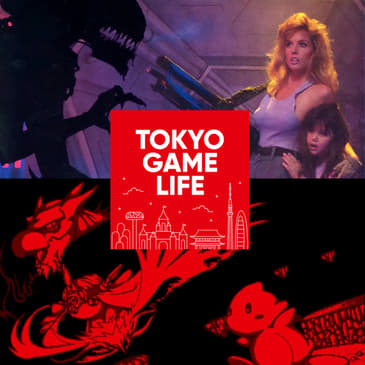
Author Mike Diver joins to chat about Japanese Alien games! From Square to Capcom to Sega, we explore how this American film franchise left its mark on the Japanese gaming scene. Plus I check out two once-canceled Virtual Boy titles, Zero Racers and D-Hopper!
Follow our guest!
Aliens: The Video Games: https://www.pen-and-sword.co.uk/Aliens-The-Video-Games-Hardback/p/58218
Bluesky: https://bsky.app/profile/mikediver.bsky.social
(0:00) - Intro
Feature
(0:51) - Japanese Alien games w/ Mike Diver
Games
(47:29) - Zero Racers and D-Hopper
News
(54:57) - New gaming merch
Social media:
Bluesky: https://bsky.app/profile/tokyogamelife.bsky.social
Twitter: https://twitter.com/TokyoGameLife
YouTube: https://www.youtube.com/@tokyogamelife
Instagram: https://www.instagram.com/tokyogamelife/
Threads: https://www.threads.net/@tokyogamelife
Website: https://tokyogamelife.com/
Like and subscribe on your favorite podcast app!
[00:00:07] Welcome to Tokyo Game Life, a Tokyo-based video game podcast focusing on Nintendo and gaming culture in Japan's capital. Your host, Mono, here to bring you a slice of gaming life from Tokyo. Author Mike Diver joins as we chat about Japanese alien games, which he covers in his new book, Aliens, the Video Games. We explore alien games from Square, Capcom, Sega and more, and we look at how this film franchise left its mark on Japanese gaming.
[00:00:34] In the game section, I look at two never-before-released Virtual Boy titles, Zero Racers and D-Hopper. Let's get into the feature on Japanese alien games with Mike Diver. In today's feature, we are looking at Japanese alien games, alien as in the American film franchise. But despite starting there, the series has left a unique mark on the Japanese gaming scene.
[00:01:01] Joining me to chat all about it is a special guest. So guest, please introduce yourself. Hello, my name is Mike Diver, and I'm the author of the book, Aliens, the Video Games, which is handy given the topic of today's podcast. Thank you so much for joining me. Today, we're looking at the history of alien games developed and published in Japan. You cover that and more in your book, Aliens, the Video Games. So before we get into the games, I want to know what led you to write a book about video games based on alien?
[00:01:28] Specifically Alien 3, because I say 4, I'm taking the Mega Drive slash Genesis 1 as the kind of base for lots of other versions of it, because it came out on the NES, on the Mars system, Game Gear, Commodore 64, etc. But then rather than pitch that as a freelance piece to various magazines or websites, I thought, is there a book in this?
[00:01:51] I'd seen some other books coming through based on entire series, be that Silent Hill or Star Trek. Obviously, you've got all sorts of different ones based just around Nintendo or Sega properties. And it turned out that there was a bit of a gap in the market to do something like this. So what would have been a relatively long piece on the development of Alien 3 video games became a whole book,
[00:02:16] where as much as possible, I've tried to get into the development stories behind some of the key games in the Alien and AVP series that have come out today. And it kind of covers all the official ones that have come out up to a point. Obviously, Isolation 2 is very public now, as is Aliens Fireteam Elite, and they are not in the book in any great detail. And yeah, it's got some exclusive interviews in there. Not as many exclusive interviews on the Japan-developed game, sadly.
[00:02:45] That just comes from trying to track people down and the kind of ease of access. It won't surprise anyone that me being based in the UK got most of my conversations in with other people based in the UK. But this is what happens sometimes. You work with what you can get. So you mentioned Alien 3. Is that your favorite Alien movie? Sometimes it is, yeah. Like most people who like the series, they're going to go for the first or second movie. But I think that Alien 3 is quite special.
[00:03:11] That was famously a nightmare during production with different scripts and different directors attached to it and what they were or weren't going to do with the characters at the end of Aliens. So the fact that you got a movie at all feels like a wonderful result, right? The fact that Alien 3 exists at all feels like a win. I think it closes that trilogy exceptionally well. It would have been so easy to have a bit of an Indiana Jones style like Ripley rides off into the sunset, right?
[00:03:41] And some of the games, three out of the four, two out of the four Alien 3 games do that. They end with Ripley leaving the planet, leaving 161 and going off on her merry way to hopefully lead a rich and fulfilling rest of her life. But they kill her at the end and I think that's really important. She dodges death in the first one, dodges death in the second one. It's going to catch up, right? It's only fair. It's only fair that the Alien has its kind of like final victory. There's something about the ending of that film where the music swells
[00:04:09] and it shows the prison facility all being locked up and it's perfect. And it kind of made me sad in a way when Resurrection reared its head and I thought, oh no, what are they doing? I was a teenager at the time. So I was like, it was just cool to have another Alien movie. So yeah, Alien 3 is a special movie. But if I had to watch one right now, I've just watched Aliens again with my oldest. My oldest son is 15. So for the first time we sat and watched that together and it was really great to watch that movie again. Yeah, I do think Alien is the better movie, but Aliens is infinitely rewatchable.
[00:04:38] Grab a pizza, put on Aliens and you're pretty much guaranteed to have a great time. As for Alien video games, it's definitely a deeper subject than a lot of people imagine. There are so many games across so many platforms and so many different genres from a lot of devs and publishers. Many you wouldn't expect and surprisingly, a large number of Japanese devs. So what is it about the franchise that attracted the attention of so many Japanese gaming companies? If you take away the Konamis and the Capcoms and their arcade game,
[00:05:06] you're looking at the smaller Japanese studios who are doing work for hire, right? So you've got these Knight Rider deals. So for their point of view, it's work, right? It's a contract. We'll talk about the 1993 AVP in due course and how that was kipped out to Japan to be made by an American publisher. And then obviously the Game Boy 1 happens in a similar way. But with companies like Konami's Aliens Arcade Game and Capcom's AVP,
[00:05:31] these are two developers kind of at the height of their arcade powers at the time, right? In the early to mid-1990s. And you're obviously looking for recognizable franchises to attach your game development prowess to. Capcom had done a lot of stuff with Marvel. Konami had its share of licensed games as well. I did Turtles and Simpsons Game, right? That was Konami.
[00:05:55] When Aliens, the Konami game, comes out in 1990, you think that's four years after it'd been in the cinema. But home video worked so differently in the 80s and the 90s. You'd have to wait years sometimes for a film to come out on VHS. And Aliens had the director's edition, right? The director's cut, the special edition. It shows that movie had life well beyond the multiplexes and such.
[00:06:23] But yeah, in terms of the appeal, Evergreen series doing really well in the home video market. When it comes to AVP, the Capcom game, there was meant to be an AVP movie long before we got one. So that Capcom game does riff on a preliminary script that had done the rounds
[00:06:46] that was supposedly in place for an AVP movie when it was getting optioned initially. So let's jump into the games. The first game you cover in the book is actually a Japanese game, which surprised me. And that game is Uchu Yusose Nostromo, which is definitely a game I feel a lot of people have absolutely never heard of. So give us the deets. What is this game and what is its connection to Alien? Yeah, so the title there roughly translates to Space Freight in Ostromo, right?
[00:07:14] So I mean, the kind of influence is worn on its sleeve up front. It was like a, I guess you might even call it a demo, something kind of made by students on the Commodore PET, the PET, in the very, very early 80s. And this little team, they'd done a game that was about hiding from a shop owner, right? You were shoplifting, basically. You were stealing.
[00:07:42] And they made this game Shoplifting Boy in 1979. And that was all about breaking line of sight and staying hidden from a top-down perspective so you could escape with items from a shop, right? And that kind of led to Alien, like taking that format and applying it to Alien. And of course, this small team of students didn't have access to a license or anything like that.
[00:08:08] So they made it based on this idea that you were getting supplies from storage rooms to escape the Nostromo. And rather than it being the shopkeeper that was looking for you, it would be the Alien. And the Alien would move after you once it had established eye contact, right? So this was put together on the PET, like I said, by a very, very small team. This is all covered. So basically everything about this game is taken from JapanSoft, which is based on the Untold History of Japanese Game Developers book, which came out in 2014.
[00:08:37] I wasn't super-duper aware of this game prior to starting research on this book, although I had, it turned out, seen the cover before for the PC6001 version of it, which did eventually come out, the home computer version. So while the PET one was almost like a proof of concept, the NEC PC6001 version of it did come out, came out in a compilation pack, AX2, published by ASCII Corp, right? From their AX series.
[00:09:05] And it comes out in a pack of four games, right? The other games are, there's one called Dual Alien, In the Woods, another game called Steel Alien. But this particular one, this Nostromo game, Space Frater Nostromo, is, as far as I can tell, the first commercially available at that time when it comes out in 1981. Game that is explicitly referencing Alien, the series. Because obviously there's lots of Alien-based video games around, right? Space Frater is pretty famous.
[00:09:35] But this is one where the people behind it have actually said, yes, we have looked at the Ridley Scott movie of 1979, and we have made a game based on that. What is our inspiration? Very clearly, Alien, the original one, which is quite funny. I mean, obviously the interviews conducted for the Untold History book are conducted much later, so it's quite funny when they say Alien, the original one, when at the time there was only one movie, right? It's just quite funny to read that back.
[00:10:03] But yeah, so in a funny way, it's like a proto-isolation, right? You've got to do things, you've got to achieve objectives while not being seen by the alien. And it's all represented, right? Basically, it's a top-down screen, it's got little icons moving around. There's no alien in it. There's no enomorph-styled character in the game or anything. But you just know that that thing on the screen is going to hunt you. And yeah, when the AX2 version came out,
[00:10:31] that's the one that people could buy based on the original pet version. So yeah, it went from a game about stealing stuff from a shop to trying to survive a kind of instant kill monster in a spaceship based on the Alien film. And that kind of proceeds, as was very much the case in the sort of wild west of the early 1980s, but a bit of a run of games, not just based on Alien,
[00:10:58] but games that would come out and they would be quite clearly based on a movie, right? But wouldn't have the official license. And so they'd have slight changes. So in terms of the book, the way the book runs, we go from Space Fairy and Ostromo through to some of the Western games that are made that are clearly based on Alien, but are not officially licensed versions yet. There's quite a fun one, actually, just as a sidebar, called The Alien. And it's about the spaceship you're on. It has all these other species on it.
[00:11:27] And you have to try and find, recapture the one that's actually going to be deadly. And I quite like that because it feels a bit like if anyone's watched Alien Earth, you know, it's a similar kind of thing, whereas spaceships got all these different species on it. It's not just the xenomorph. That's quite, it's quite fun to look back at that and go, oh, I'm sure that was not an inspiration for Alien Earth at all. But it's just nice that the Alien Earth game kind of exists. And it came out in 1982. Yeah, I guess it is appropriate that one of the first survival whore-esque games has at least some tenuous connection to Alien.
[00:11:56] And it has a very cool cover as well, although obviously it isn't really captured in the graphics, but you can use your imagination. Yeah, yeah. Like you said, they're not using the xenomorph in the cover of it either. It's very clear, let's not upset the lawyers. So let's jump to 1987, where we got the first Japan-developed Alien game, which is Aliens Alien 2, just in case you were confused by the renaming. And it's a 1987 game on the MSX. And out of all the Japanese devs out there,
[00:12:23] I think most people would not have expected that Square developed this game. So give us the details on Aliens Alien 2 from Square. Yeah, I mean, like you said, this is officially licensed. Square at the time are definitely not the company that would go on and become the Final Fantasy studio, right? They were making other things at the time. They were porting stuff. They were taking pre-existing titles and putting them on other platforms. They definitely weren't synonymous with Nintendo,
[00:12:52] which they became for a little bit there. So Aliens Alien 2, which I believe is named after the way that movie was marketed in Japan. Maybe Aliens, just pluralizing it, didn't carry over quite so well. I've definitely seen posters with Alien 2 on it, just to make sure you knew what was going on. So yeah, the idea there, Aliens was having a couple of home computer versions made by companies in the US and the UK. And those were both, one was very like, here are bits of the movie.
[00:13:21] The other one was kind of like a proto first person survival horror, which is really cool. For this one, this is, I respect this. It's not an arcade game, but it basically is right. So it's your side-scrolling action shooter. Ripley, you play as Ripley, you can jump around. And it's really focused on the rescue of Newt. It doesn't really look like it necessarily. She starts on the outside and makes her way into the complex, the Hadley's Hope complex. There's some really bizarre level design with doors,
[00:13:50] going in and out of doors and trying to find the right way through and trying not to fall into an infinity chasm of death. You get to fight this huge kind of queen alien between levels. It's not just like there's one and that's it. So it does take some liberties with the source material, but is a run and gun action platformer, like you say, made by Square, which does a relatively good job of capturing what Aliens is about. There's a lot more action packed. There's more guns in it. There's more aliens being shot.
[00:14:20] It's not the smoothest playing of games. If you want to play an Aliens side-scrolling shooter, then obviously go to the Konami game. But it's interesting. And it's a novelty amongst collectors, definitely, because it only came out officially in Japan on the MSX. There was an NES version, which you can find mostly complete versions of online or a Famicom system. I think it might have been Famicom Disk System originally as well. But for whatever reason,
[00:14:50] it didn't meet the standards Nintendo were trying to set for itself at the time. So it didn't go forward, or at least that's the information that I could find. It just felt short of quality standards, which given what did come out sometimes is a bit perplexing, because it is perfectly playable. But yeah, it's got some interesting people involved in it. I always regret trying to say Japanese names at the best of times, but you've got Takashi Tokita,
[00:15:17] who would go on to design Final Fantasy IV and then direct Chrono Trigger, right? You've got, goodness me, the Final Fantasy composer, right? Yes, Nobuo Uematsu. Thank you very much. So he works on the music to this, and that's a really, really, really cool connection. He's not credited by his real name. His credit is Kentaro Hayabusa. And he does this very eerie, very kind of minimal synth work in this. It's a long way from the really swelling,
[00:15:47] soaring strings of the Final Fantasy series. But yeah, it's got some names attached to it. It's got some fun things in it, but it's not in and of itself a great game. A novelty. I quite like the end of it, where it tells you that there's a whole planet of these aliens waiting for you. And I'm like, that's almost like the end of Alien, right? That's not the end of Aliens. The end of Aliens, very famously, they don't nuke the site from orbit, but that was the plan, and it blows up anyway. So again, some liberties taken,
[00:16:17] but a game that anyone who has an affinity for Square products or Alien games, it's worth a look. And I certainly wouldn't expect anyone to seek out an original MSX copy. Yeah, I think maybe the most interesting element to me about it is that Nobuo Uematsu did the soundtrack for the game. And he worked on nine soundtracks in 1987, one of them being Final Fantasy. So I don't know if this would rank as the best work he put out that year,
[00:16:45] but it is worth listening to because it is very synth heavy. Yeah. So let's jump to the 90s with Konami's Aliens, one of the mini run-and-gun Konami games from around this time. So what can you tell us about Konami's Aliens? Konami picked up the license quite a way before the game came out, stuck to their strengths, made a belt-scrolling action shoot-em-up. It does have some into-the-camera parts as well, has some quite interesting boss fights where the aliens have some very, very different designs
[00:17:14] to how they appear in the movie, like weird long-necked creatures. There are flying aliens. There are zombies in this game because why shouldn't there be zombies in this game? It has some fun with the license. I suppose if anyone was familiar with the Kenner toys that were doing the rounds around the similar period, these really bright-colored alien toys, it feels like a game that's leaning into that a little bit as well. The toyetic side of, which is a weird thing to say with aliens,
[00:17:42] but it does lean into those kind of toyetic design, that the aliens are really brightly colored. There is obviously the need for things to stand out on a screen to make things recognizable, as in that's the thing you can pick up, that's the thing you can shoot, that's just a piece of the environment, right? So there are design elements at play which kind of dictate how creatures, enemies should appear. But yeah, it's a terrifically fun, quite short, as arcade games should be, exceptionally hard.
[00:18:11] It was very well received at the time as well. Jazz Rignall, who's a terrific journalist of old, and actually is somebody, he's got his own book out, The Games of a Lifetime, which is well worth a read if you want an insight into how it was working in the games world in the 80s and the 90s, and just the difference to what it is now as a journalist, a critic and such. But he was absolutely won over by it, and he's a guy who certainly knows his arcade machines. It's quick, it was intense, it has some really fun weapons you can pick up,
[00:18:40] just like huge, great big rocket launchers and stuff. You get to see Newt running around in the background every now and again. You can toot a lot of run-and-gunners, it's not really a run-and-gunner, belt scrollers at the time, you've got a two-player option, so another player can play as Hicks, who again does not look like Hicks from the movie, but that's absolutely fine. And yeah, it's a kind of typical product of its time that also stands up today, in a way that like the Simpsons game can, right?
[00:19:09] With friends, it's fun. A bit better than the Turtles arcade game, I would say, which kind of suffered for its very floaty sword combat. This is a lot meatier, there's a lot of substance to the way that these aliens blow apart when you hit them with something. Yeah, and it ends with you fighting the queen, and who doesn't love to fight a queen with a power loader? Yeah, a common trend in a lot of these games is that, oh, we can just make up our own alien designs, and nobody will say no, we can just do whatever we want.
[00:19:38] And I've got no idea who this blonde woman is supposed to be on the arcade flyer. I guess that is supposed to be Ripley, but they couldn't get Sigourney Weaver, but I think you should at least get a brunette or something in there. It's a choice, isn't it? Yeah, if we can't get Sigourney, let's go not as far away as we could, but yeah, for it to be a blonde woman is a definite choice. Yeah, but I'm a big fan of this game because it's got great presentation, and it does kind of capture the feeling of the film, even though it changes so much. There is the part where you have the radar and you're crawling through the vents,
[00:20:08] so they take some interesting liberties, but they also are faithful to the film at the same time. And yeah, it feels like an expansion of the movie as opposed to doing something totally or completely different. So we've got Square, we've got Konami, and next is Sega in 1993 with the awesomely titled Alien 3 The Gun. Oh, right, yes. This is on the System 32, which was Sega's first 32-bit arcade board, and I think most people probably know it because Jurassic Park also runs on that arcade board.
[00:20:38] Tell us about Alien 3 The Gun. Oh, yeah. I mean, talking about things that are just a blast to play through. It's the Alien 3 adaptation that's the furthest away from the source material, while also really sticking to it in some ways. You don't play as Ripley. You are unnamed Grunt 1 and 2, if playing with a friend, and you start off on the Sulaco, and the Sulaco's full of eggs, and you have to fight your way through, and you get down to the planet, and you're shooting all these robots, and the first boss is a giant facehub, because why not?
[00:21:08] What on earth is that going to attach itself to, right? It's just bizarre choices. But then it has things like, it has the sequence where you're following the prisoners through the tunnels, which is really fun. It ends with a fight against an unnamed man from the company, who we assume is the Bishop character at the end of the film, which again, I love. It doesn't show Ripley in it. It ends with you dying, which is quite fun. It's like, oh yeah, you win the game,
[00:21:36] and then more soldiers show up, and murder you in cold blood right there. It's just, yeah, it's a light gun game, which is, remained exclusive to the arcade. It didn't leave the arcade. And like you say, it uses the 30, the System 32 board, so the super scalar stuff, like Radmobile, Sega Sonic the Hedgehog as well. So it has the kind of clippiness to it, but once you get into it, like that Jurassic Park game is crazy. That Jurassic Park game is,
[00:22:05] if you enjoyed that Jurassic Park game, but needed to tone it down a bit, like weirdly, this is where you end up, right? Because that Jurassic Park game is almost too much. This feels a little bit more grounded. But yeah, in some ways, it's your standard. Like gun game, you know, play with a friend, shoot a load of stuff on screen. But it draws from the movie in some interesting ways. It has the runner alien in it. It names the runner alien, so that's quite a fun thing. It actually has the specific alien from Alien 3.
[00:22:34] You do push it back into the lead, and that's how you kill that alien. But at the same time, it has this wild, it's almost like a side telling of the story, right? Like it's not focusing on the main stuff, but it's not quite an alternative telling, but it's silly, but in all the right ways is what I'm saying. It's just, yeah, if you can find a cabinet, which is really hard these days, there is one I know of in London, in Stoke Newington. But yeah,
[00:23:04] it's just great. And the guns themselves, they feel so good. That's a weird sentence I didn't think I'd be saying on a Sunday morning. But yeah, the guns, because I don't know about anyone else listening, but when it comes to light gun games, I mostly grew up with, well, I had a mask system. Whether you had the mask system, phaser or the NES zapper, the Famicom zapper, that was your light gun experience at home. To actually hold one of these big chunky rifles and shoot at aliens in an arcade with everything screaming at you and going off is just really good. And the alien,
[00:23:34] there were other alien light gun games that came afterwards, but they maybe were a little bit too wildly different from the source material. They had some even weirder designs. They tied more into the Konami designs in a weird way. Everything feels quite grounded in Alien 3. it feels grim and dirty like Alien 3 does, right? Everything's covered in overmorphs and slime and muck and then you're in the facility and everything's grimy
[00:24:04] and horrible and just getting to the prison, to the leadworks. You have to fight through these junkyards of killer robots and stuff and aliens running around in the background with the parallax scrolling. It's just a lot of really aesthetically it's very on point even if narratively it's completely not. So we've gone through Square, Konami and Sega and now Capcom enters the fray with Alien vs. Predator. Not to be confused with the other Alien vs. Predator games from Western Devs
[00:24:34] that released a year earlier. And this is a beat-em-up based on the Alien vs. Predator comic series and features characters from the Predator series and a new one created by Capcom Lynn Kurosawa. So tell us about Alien vs. Predator from Capcom. Here is Capcom at the absolute peak of their arcade powers taking an IP which is on the rise all the assumption is that it's going to be a movie soon. It runs on the Play System 2 board so it's the
[00:25:04] Super Street Fighter 2 turbo board. Everything looks great it sounds great it moves fast it just fills the screen with these different colored slightly different styled xenomorphs it has a few really interesting bosses in it as well like again variants on the Alien maybe this one was birthed from this creature that creature whatever interestingly the game that precedes this the Super Nintendo one the Super Famicom one which while published by an American publisher
[00:25:33] was made in Japan that one does a really fun thing where the boss you're about to fight you can see what it came from earlier on in the level like in the background art I love those that little touch you're gonna fight a snake alien there's a snake like dead snake before you reach that alien so just a really cool touch but yeah Capcom AVP of 94 you've got I always felt that the two predators were too similar to each other you're kind of middle of the range characters but then you've got Lynn like you said who's newly created for this
[00:26:03] she's my go-to character of choice with the speed she has the versatility the kind of way that she can get across the screen and avoid stuff a little bit better I'm more familiar with her kind of move set but the character Dutch is like the tank right just this huge great big android guy or whatever you want to say with and he was with a big cybernetic arm the original thinking behind that was like he would be able to replace bits of his arm as you went through the game and have different additions to it
[00:26:32] different plugins but that didn't quite come to pass but yeah if you're a predator guy they've got all the normal weapons you would expect they have a spear you can get these razor sharp I don't know what they're called technically the discs you can throw out you can pick them up and throw them around you can't cloak yourself I think that would have been a bit overpowered but what's quite fun actually is people talking about this game the idea is that the aliens don't have eyes right the xenomorphs don't have eyes like we normally see so they
[00:27:02] would detect vibration and pheromones and such so even if you were cloaked like the alien would still know where you were so just something to bear in mind when you watch those films and the predators sneaking around all quietly but yeah I still love this game I play it a few times a year I've got it on the Capcom home arcade stick so I can play it with my kids just yeah just one that really holds up I know there's always been a big clamor for it coming to home systems it never has and it
[00:27:31] almost certainly never will outside of any kind of dedicated you know like a like I think Capcom already did a belt scrolling collection but if they did a volume two or something maybe there's a way to make it work but they certainly tried to they wanted to release it Capcom wanted to release it and most famously they were trying to get it out around about 2000 so you're looking at the ps2 era but that didn't happen and Fox the license holders thought that the kind of the game was in the past they were moving on to horror they wanted alien games
[00:28:00] to be scary not just action-packed but before that I'm a Sega guy cut me and I bleed blue etc so the fact that this was also once targeted for the 32x that would have been great getting this on the 32x I'm not saying that add-on needed a system seller but it couldn't have hurt to have a game like this on it yeah to me this is an absolute classic Capcom beat-em-up it's got fantastic graphics and awesome unique designs for the aliens and it's gory and you've got all these great
[00:28:30] weapons and I think the main complaint is what you touched on is that the Predator characters are just way better but I guess that makes sense compared to a human or even a cyborg though Lynn Kurosawa Capcom's original character has a lot of fans and she has appeared as cameos in other Capcom games like being in the background of Street Fighter 3 and she's also a very highly requested guest character for Street Fighter which yeah I think they should put her in here or put her in Street Fighter if Capcom owns her wholly and yeah sadly AVP has never really gotten
[00:28:59] a big re-release you mentioned the Capcom home arcade plug-and-play console in 2019 but yeah no real home ports although I did read an article that said this was from a while ago that oh an HD-ified version of AVP is one of the most requested games they get but I don't know what's going on with Disney Disney has been a bit more open in terms of yeah we can release old games they have so many like the Disney afternoon collection yeah and things like that so hopefully one day they get around to AVP but maybe Capcom is a little
[00:29:29] too busy but I'm still hoping I'm holding out hope yeah yeah Capcom's having a pretty good 2026 right now so I don't suppose that this I know if you if you believe everything that's coming as well they've got some some other franchises that are due for a revival but this is exactly the kind of game that if it came to like I said you mentioned the Disney afternoon collection right it would be terrific for a package like that with a few other alien games or just with other Capcom games depending on how it comes to pass I'd love Digital Eclipse or a company
[00:29:59] like that to be given the opportunity to put together an alien package and pull some of these games together but I don't think it'll happen somehow now to jump a decade ahead in 2006 Sega procured the alien game franchise and it would take a few years until 2010 until we saw aliens versus predators no relation to the previous game which was a first person shooter not developed by a Japanese dev but was indeed published by Sega and they've also partnered with some other interesting Western devs like way forwarding gearbox
[00:30:28] and make alien games but yeah they haven't made a in-house alien game or even reached out to other Japanese devs I guess it makes sense because if you have a Western IP you probably want to give it to a Western dev you know back in the day during this day we talked about if you want to make a game you've got to go to Japan to get it done that's why we got Batman from Sunsoft and these alien games from a variety of Japanese devs but now it's hard to imagine oh a Japanese dev is going to make the next Lord of the Rings game
[00:30:56] or whatever but if you had a dream collab between alien and a Japanese developer who would it be and what kind of game would it be? It would please me greatly to see the Capcom or something like that kind of get a chance to go at it again right they proved themselves many years ago with the AVP game and what's to stop them doing the same again? Well I'll tell you what's to stop them they've got a hundred other projects on the go. You've got like you say you've got alien games coming out they are mostly from Western studios right now and I
[00:31:26] think history shows us that you do get some really cool alien games from Japanese studios. I know that Creative Assembly who are doing isolation and isolation too you know that is owned by Sega that's Sega studio. So it's not like they're outsourcing it to a third party. I think maybe just because I've been playing so much Pragmata and Resi Requiem early this year is probably why Capcom's come to mind but lots of people who are listening would be like oh Studio X would be great to pick up this. I don't know if there's ever been
[00:31:55] like a alien JRPG. You could do like an alien versus predator JRPG where your team is a mix of predators and humans and I don't really have a preference you could get somebody like Arte Piazza or I don't know Monolith Soft and I'm sure it'll be good. Now this isn't a Japanese dev but it is published by Sega and I think we got to touch on Alien Isolation a survival horror game from 2014. It came out and got pretty good reviews not like amazing reviews or anything like that and Sega said soon after launch that it
[00:32:25] underperformed in sales. However I feel like this game's reputation has grown immensely over the years and it's one of those cases where at launch it didn't make a huge impact but people have been discovering it over the years and it's inspired a lot of games and I kind of want to just draw the line between Alien Isolation and the modern Resident Evil games. Maybe there's no connection it's just a coincidence but I think a lot of games have definitely been inspired by Alien Isolation. So what would you say is Alien Isolation's legacy?
[00:32:53] In terms of making a it's funny you mentioned Resident Evil because I think of Nemesis and the way that the idea was that you would always have to escape this gargantuan creature that was going to smash you to pieces if you let it right? It was an unbeatable enemy and what Isolation does is make the alien that unbeatable enemy. I suppose the difference is whereas with Resident Evil and you've got I was replaying Resi 2 the remake early this year off the back of Requiem and
[00:33:22] obviously the way that you're kind of stalked through the police station has echoes of isolation right? The way that you can kind of listen and you can hear where that where Mr. X or whatever we're calling him the tyrant where it is but that's something designed to move you on right? That series is set up to move you on. I suppose in Requiem you've got that stage that sequence with Grace having you when you're trying to hide from I can't remember the name of the girl the big girl
[00:33:52] who's gonna the big girl what a thing to say. Well you hide quite early on and you're in the hospital is it? Yeah. That's a proper creeping around and hiding from this thing but it follows relatively set patterns. It still is if you do it two or three times you know you have to hide here you know you've got time to get to that box to get that key and you can then hide back down under this little table down here sort of thing. I think what Isolation do is it did is it made that relationship
[00:34:22] way more dynamic. It made it way more way more important that you kept where that enemy was in your mind at all times. I don't think you ever have or very few times in that game especially if you're playing it for the first or second time. The alien does have queues. It has places where it can and can't go. It has times where it will trigger automatically and other times where it doesn't. It has spots around each level where you know it's it has a chance of being right and there are clues to it to help you. You only walk under a
[00:34:51] dripping vent once before you realize that you probably should do that again. But yeah the fact that it's set up so it could appear anywhere and the and it presents itself to you as being unable to fully understand right. The way we still talk about is intelligence the AI involved and of course it does have very advanced AI for what it is but it's still following a relatively limited set of rules but that limited rule set
[00:35:21] actually allows it a great degree of flexibility of go here or flee from that or go towards that or follow that sound follow this sound. And what I like about isolation and it's mentioned in the book by one of its designers is that alien doesn't cheat. It learns on the job. It learns as you play. It won't do anything that you haven't seen it understand if that makes sense. If you shoot that thing with the flamethrower once or twice that's how it
[00:35:50] understands not to run towards the flamethrower right. It won't do something off camera where something happens and at that point now it understands the flamethrower rule. It has to happen in front of your eyes. So I think the way that the alien does learn adapt is obviously a huge legacy in terms of kind of cat and mouse play and proper survival horror. If that thing comes for you, you cannot. Unless the flamethrower is a little bit of a cheat code for a while because it means you can
[00:36:20] move around a little bit more freely. It doesn't really matter. You can send it on its way once or twice. Probably only once or twice. You don't want to overuse it. But in terms of it helps that it was developed for what it was developed for right. We're well into the HD era. We're using some pretty detailed assets. The fact that it can recapture the atmosphere, the environmental design of that movie that it's drawing so much inspiration from the original Alien,
[00:36:48] that's obviously huge for that game. We talked about other games taking liberties and sometimes they do that because they want to. Oftentimes they do it because they have to, right? They're working with a very limited tool set. The hardware of the time is not capable of producing the kind of environments or character models that in an ideal world those designers would have created. So isolation changes that. And as soon as you took and bearing in mind that was at one point going to be a third person game. They were playing around with the idea of you'd be able to see Amanda Ripley. You controlled her in a
[00:37:18] third person capacity. As soon as you remove that model, you know, it gives you more capacity on screen, right? More room to build out the detail of the environment because you haven't got the character model anymore, right? You've bought yourself more polygons and more textures and more details. And that really lends itself to that just skulking around that place. And just being able to see, again, you mentioned Resi, the switch that Resi made to first person while it isn't for everyone. Like if you're coming to
[00:37:48] that series new and maybe you're coming to off the back of games like Amnesia or Alien Isolation or games like that, being able to see the horrors with your own eyes, it grounds you in the experience a lot more, right? You can't always see all around you. It's not like you're a little third person model. You can spin the camera around and check all of your angles. You can't do that in first person. And Isolation, that team, I think as soon as they saw that it worked in first person, they were like, that's it. We got to do it.
[00:38:17] And the decision was made. Funny enough, like Resurrection, the Alien Resurrection game had a similar incident during its development where the team were making a very different game and then they set it up as first person and went, oh, that works. We need to take it to the publisher now and get them to approve it. And they did. But yeah, with Sega, it just worked. And Isolation as well, it's a game born out of luck in a way. You had Creative Assembly who had started making more action orientated games for
[00:38:47] Sega. They did a Viking game. They were planning a Robin Hood game. And they had this demo which was just set on the moon and it was meant to be this viral outbreak on a moon base, right? And then Sega said to them, that's great and everything, but we've got these two opportunities. You can do the Olympics or you can do Alien. And I love the idea that there's a sliding doors moment where Creative Assembly go, you know what, we'll do the Olympics. And then Alien Isolation doesn't happen. They had this demo which
[00:39:16] they then changed to a, it's not like it's overnight, but the demo that you can find online, which is the one that kind of sold Isolation into Sega, they made it in at most a couple of weeks. It was a real kind of like fast and loose process and it just nailed it. Like atmosphere, straight away, got it. Like horrible, like creature, when the Xenomorph descends from the ladder above and you just comes at the player inverted commas with its jazz hands, a bit
[00:39:46] like the first movie. That's it. You're sold on the experience. So I get, we were talking about Legacy and I've just rambled off, but what Isolation does really well is it has a respect for its source material that allows it a degree of wiggle room in terms of interpretation and where it wants to take some story beats and like some, some design aspects, but keeps it so attached to a movie that you said up front is your favorite one that continues to find new audiences. That you get, you
[00:40:16] bounce from watching Alien to playing Alien Isolation. You're like, yeah, this feels like two sides of the same coin. This feels like the same thing. And that, that's what's so terrific about that game. And I really hope that it's not an over familiarity, but I hope that kind of connection to the series, to its aesthetics, to its environments, to its just mood setting. I hope that continues into the sequel from everything we've seen. It looks like it will. So I'm very excited for that. Hopefully it still
[00:40:46] delivers. I would love, like we start talking about Alien 3 as well. I would love someone somewhere to find a way to not adapt Alien 3 exactly, because that ship has long since sailed, but do the Alien 3 game, but in an isolation style, right? That kind of creeping around the vents and seeing the chaos unfold in real time, right? Because like what we don't get in isolation, like with isolation, the chaos has already happened, right? To a great extent. You arrive at
[00:41:15] Sevastopol, things are already a mess, but like an Alien 3 one where like it's happening before your eyes would be really cool. And you're the one who knows about it, but there's nothing you can do to stop it. Yeah, I think that game just has such an interesting, I don't know, path. Typically for a lot of games, you know, it comes out and it's a big hit and then it's, it goes on from there. But there's not so many games where they have a tepid launch, but then people years later realize, oh, that was a game changer in many ways. And it's definitely very impactful on the
[00:41:44] survival horror genre. And yeah, it's interesting that you said, oh, maybe Nemesis inspired the Alien. Technically you could do the Alien movie maybe inspired Nemesis, which maybe inspired Alien Isolation, which maybe inspired the modern first person Resident Evil game. So it's interesting how that all works. And now since I'm a big Nintendo fan, of course, I got to shout out that Metroid is, I don't want to say a rip off of Alien, but obviously extremely similar to Alien and very heavily inspired by Alien. So what are some other
[00:42:13] games or references that you feel are really inspired by Alien that come out of Japan? In terms of what we've seen in other games, you're right to point out Metroid. The people who've worked on Metroid have been quite upfront about that, but let me think Contra, quite famously, right? Contra is definitely, definitely showing its xenomorph influences there. There's a game that Taito made called Space Gun. It's like a light gun game that's very heavily Alien inspired. So you definitely get them
[00:42:41] around all sorts of things. You can see anything that has the slightest bit of biomechanical aesthetic to it, right? Enemies or environmental designs, you can see it in drawing from Alien and Aliens. One of my favorite games, we talked about how great Capcom's AVP is, but I love Streets of Rage 2. I absolutely adore Streets of Rage 2. And that has a theme
[00:43:11] park level, right? And you go from the pirate ship, the swinging ship, and through the pirate level, and you end up in what is effectively an alien experience that you walk through. And I'm just like, what on earth is this? And it has these glowing eggs. And they haven't got facehuggers in them, but they've got little tiny, little, slightly xenomorph-shaped old babies in the eggs. And of course, the game it is, you can blow those up and find a thawed or a roast chicken inside or something like that. And the walls are all covered in the kind of
[00:43:40] hive-like structure that you see in Aliens. And it's one of those games where obviously it's using, which I've called it like tiled, right? The background is tiled, so it's the same assets repeating. But I played it again recently, and I'm looking and thinking, there is just that, are there xenomorphs in there, like in Aliens, where they blend into the walls? And there maybe is. Another game I'll shout out as well that definitely pulls in from Alien, although not necessarily obviously a snatcher. So obviously the Konami game that Kojima
[00:44:09] worked on originally before it came to the West with the Mega CD version. But there's a wonderful scene in that, which you may know about, where they go to a bar called Outer Heaven, or you as the player goes to this bar as Outer Heaven. It's like a sci-fi cyberpunk detective game, one of my favorite games. The crowd in this club, they're all meant to wear masks, and so they just took from film, so that the original release of that has an alien in that bar. Why wouldn't someone just dress as a xenomorph? And in the official documentation, they're called I-Lian.
[00:44:39] They're not called Alien, they're called I-Lian. They're just dressing up as an alien, which is really great. When it came to the Mega CD version, they took that out and replaced it with Konami characters like Sparkster and stuff like that. But yeah, I didn't get into all the different alien influences in the book, because that would almost be a book in itself, but like you say, there's a lot out there. Metroid, quite famously, just in terms of the atmosphere, not just the designs, but when you play Super Metroid
[00:45:08] now, it's creepy, right? It's really good. And what's interesting about that is that came out in 94. The Alien 3 game on SNES came out the year before and is also a really good Metroidvania game. So it's interesting that the game that kind of gave us the name for what we're calling that genre, that kind of exploration-based action platforming, actually has a really great
[00:45:38] predecessor, which is explicitly an Alien game as well. So Alien 3 on SNES is just a wonderful thing. Not as good as Super Metroid, of course, but it's still really cool. Yeah, that's a good point. You could think of Alien the movie as the first Metroidvania in some respect. And yeah, Alien is just one of those series that inspired so many people and then they made art and then that art inspired so many people and so forth and so on. So it has left a very indelible mark on Japanese gaming, whether you know it or not. And I also just think the xenomorph design
[00:46:08] in Japan, we've got the kaiju and monster design is such a big element of sci-fi and pop culture. So I think the Alien design, the xenomorph design, that definitely got stuck in the minds of many Japanese creators and then they created so many fantastic games and so much fantastic art from that. So that was a look at Japanese Alien games. Mike, where can people find you and where can people find the book? So in regards to the book, find it wherever you can if you're interested in it. But if you want to go to the publisher, which is White Owl Books, you'll
[00:46:38] find it on there. Availability worldwide does vary in terms of when it's out. So check your local stockists, I would say, your regional stockists. And in terms of myself, if you want to follow my babblings about anything, you can find me on Blue Sky. Just look for Mike Diver on Blue Sky and you will find me. But yeah, I just hope that this book finds the right audiences. Whether you really love the Alien video games or just like the Alien series and want to learn a bit about how that transferred to video games, hopefully there's something in there.
[00:47:07] I didn't write it for the hardcore. I wrote it for the slightly more casual Alien fan, I suppose. Great. And the links to everything are in the podcast description. So listeners, check it out. Mike Diver, once again, thank you so much for joining me. Thank you so much for having me. It's been wonderful chatting to you. Today in the game section, we are looking at two, count them, two Virtual Boy games, Zero Racers and Dhopper. I already did a big episode about the
[00:47:36] Virtual Boy's return on NSO, and since then I have been checking out the new additions, but this is by far the biggest addition, not only for Virtual Boy, but I would argue for all of NSO. Why? Because these are two never before released games. They were developed in the 90s, finished 100%, but shelved because the Virtual Boy was on its way out. Ironically, I think Bound High is the most famous example of a finished yet unreleased Virtual Boy game, but to me, these two are a bit more interesting, especially Dhopper.
[00:48:06] Now, obviously, the history of these games kind of overshadow the actual games, at least for me. None of these titles are really going to rock your world and Wario Land is still the best Virtual Boy game by a pretty large margin. But again, from a historical perspective, these are cancelled games that are now fully released decades later. How often does this happen? I mean, with Nintendo, it has happened before in that we got Star Fox 2. And it could happen again in the future, maybe with Sound Fantasy or something. But a year ago, if you
[00:48:36] said, hey, this time next year, Dhopper will be fully playable on your Switch 2, people would say you were crazy. But you know who did say that? It was me. Check my 2026 predictions episode where I specifically called out Dragon Hopper, a.k.a. Dhopper by name, and said that Nintendo would release once cancelled games on NSO in 2026. When you're right, you're right. I mean, what other podcast said Dragon Hopper is coming in 2026? This is the only one, baby. You're listening to it.
[00:49:05] So let's get into the games. Ironically, I think Zero Racers gets more attention since it is kind of an F-Zero game. That was the intention, but I don't know if it's officially integrated into the F-Zero canon now. I suppose it is just categorized as a spinoff, but it is indeed a racing game where you are behind a futuristic vehicle and drive around a track. Though drive might be underselling it, you're flying around a track. You're not just a car on some futuristic pavement, but instead you are controlling a flying ship. So a little Star Foxy
[00:49:34] there in terms of the perspective. And this opens up a new element to the F-Zero series, the Y-axis. In the other games, you just got to worry about obstacles on the track and hitting those tight turns, but now you got to go up and down and around. This alone, taking full advantage of the 3D space, is an interesting twist on the typical F-Zero formula. But one thing that is hard to replicate is indeed the sense of speed. It doesn't feel as fast as even the SNES game. It feels very much hampered by the hardware and the need to control your vehicle
[00:50:03] in a more larger 3D space. And the graphics aren't anywhere near as iconic as the sprites of the SNES F-Zero. Everything is just wireframes, kind of like Red Alarm on the Virtual Boy. This almost looks like a fake game from an 80s sci-fi movie about the future. And while I do think the red and black aesthetic of the Virtual Boy and the wireframe graphics are incredibly cool and evocative, it does wear thin when multiple games use it. Like Red Alarm, the wireframe aesthetic really added a lot, but here it
[00:50:33] does make it seem like it's unfinished. Maybe there was a tech issue or a time issue or they had difficulty conveying all the obstacles in 3D so they wanted to make it as simple as possible, but it definitely looks unfinished and maybe technically it is. Some of the ships look like TIE Fighters, so maybe this would have secretly worked better like as a Star Wars game as opposed to an F-Zero one. To me, this functions purely as a curiosity and not as a game you really sit down and try to master. But fortunately, D-Hopper is much better. It is developed by
[00:51:03] Intelligence Systems, who I would probably say is the greatest developer of all time. And something we learned with this release is that the director is Ryota Kawabe, who directed Paper Mario on N64, also the greatest game of all time. So this game already had a lot going for it. Unfortunately, it is a pretty solid game built on an interesting concept. It is essentially a vertical platformer where you are observing the character from a top-down view and you are jumping up to a higher platform in order to reach the heavens. I mean, there must be other
[00:51:32] platformers with the same idea, but probably not many. It is an interesting and fresh take on the genre where you are mostly jumping up as opposed to around or side by side. Is this technically a 3D platformer? I guess it is kind of 2D, but the 2Ds are different from the other Ds in, say, Super Mario Brothers. But maybe it is indeed 3D. You go up and down and you go to the side. So no matter how many Ds are in this game, I would say it's absolutely worth firing up if you haven't touched your virtual boy in a while.
[00:52:01] It is kind of a puzzle platformer at times, but mostly simple puzzles like needing to find a key to unlock something. Although, is that even really a puzzle? That's more of a go find something and then come back kind of thing. There's more exploratory elements and it relies less on Twitch reactions, which is very smart considering the unorthodox viewpoint of the game. And smartly, you do kind of have a little Yoshi flutter jump to help you be a bit more precise. I think the devs knew that it might be tough for some people to wrap their brains around this type of game, so they did design it around that idea. And speaking of Yoshi, you
[00:52:31] play as a little dragon guy with a fairy companion. And what is it with 90 games in fairies? I feel like we don't see fairies so much anymore. The Adventures of Elliot had one, but everyone said she was really annoying. But once upon a time, nearly every game had a fairy in them. And the Ocarina of Time remake is coming up soon, so maybe we will have a fairy renaissance. Oh, and the dragon can also transform into other types of dragons. Like the Earth Dragon lets you do an earthquake attack, and then you can select your transformations via a weapon wheel, or maybe a transformation wheel is what
[00:53:01] you should call it. I mean, is this not just the perfect Smash character? You jump and you transform into different dragons. Sakurai, all the work is already done for you. With this update, the Virtual Boy NSO app also has different color schemes, so you can escape the red and black if you so choose so. They actually added quite a lot of colors, cyan, magenta, etc. But there are schemes specifically modeled after the Game Boy. There's the OG green, pocket, color, and even Super Game Boy, which gives way more colors to the graphics.
[00:53:31] This is by far the best looking one, and it does make me want to try out every game with this look now. And I got to say, way easier on the eyes than the red. I don't think having these color schemes would have saved the Virtual Boy back in 1995, but it would have at least helped a little bit, I think. But hey, why do we have the Super Game Boy color scheme for the Virtual Boy app and not the Game Boy app? I mean, that's just classic Nintendo decision making. So Zero Racers and D-Hopper, worth trying out for curiosity's sake.
[00:53:59] I will say D-Hopper is at least solid from what I've played. I don't think I'm going to clear it, but maybe I should for street cred. It is a genuinely interesting idea on the platformer genre, and it does feel smooth to play. It is a fully realized concept. I do kind of wonder if they were ever to deify these games, but that task is a lot harder than it seems, especially for some specific games. But I am very glad Nintendo is digging up canceled games and releasing them. It does give me hope for sound fantasy or maybe some Satellaview stuff. Nintendo is not afraid to do some really deep cuts, which is great.
[00:54:29] It makes it seem like nothing is off limits. Will they just translate these Satellaview Zelda games and release it for the Zelda 40th anniversary? I mean, maybe. All right, that's all for games, so let's check out the news. We're getting a Dragon Quest themed The Game of Life in Japan from Takaratami this October. You probably played Life once ever and then never thought about it again, but in Japan, it is basically the board game everyone has played.
[00:54:59] It's bigger than Monopoly, bigger than Uno, bigger than Shogi even. More people have definitely played Life in Japan than Shogi. This is one of those things where I thought, wait, this has never happened before, but it's happening now, so check it out this October. Speaking of more merch, Nintendo Tokyo has released truly an insane amount of Animal Crossing merch these past few weeks. I can't even list everything here, but we are talking towels, water bottles, keychains, makeup, you name it, they probably released it. We got the Switch 2 edition
[00:55:29] this year, but I did not expect this flurry of merch to coincide with that. But the game is extremely popular still. It sells a lot each quarter and a new Animal Crossing, maybe not soon, but is going to be a major system seller once it hits. I do wonder what the sales expectations are for a new Animal Crossing game. It's kind of like Mario Kart 8, where there's likely no way the sequel touches the numbers of the Switch version. New Horizons is at 50.29 million. So would lifetime sales of a Switch 2 Animal Crossing
[00:55:58] game at 30 million? Is that a massive disappointment? That's a very silly thing to think about, but like with World, I do think there will be a lot of hand-wringing about the game's performance. The Duskbloods. It's real, and there's an online test happening right now. I actually didn't sign up for it since I am a little busy this weekend, and also I kind of want to wait and try the quote-unquote real version, but we at least know more about the game that is allegedly releasing later this year. I think to sum it up is that it is kind of like a Dark
[00:56:28] Souls version of Kirby Air Rider's City Trial. You have a big map you explore, you level up and collect points, and then there are phases, and if you don't have enough points, you're eliminated, and at the end you have a randomized or somewhat randomized battle where that determines the ultimate victor. So, kind of like City Trial, where you explore a map for five minutes, you level up your character, and then you pick one challenge to do, and then if you win the challenge, you win. But while Kirby Air Rider's City Trial has multiple winners, this one only has one. And I don't know if Target Flight is going to be in
[00:56:57] Duskbloods, but even the idea of a Kirby Air Rider's adjacent Dark Souls-esque game, that's pretty interesting. I mean, City Trial, one of the greatest multiplayer modes ever. I loved the Kirby Air Riders version. I played mostly that out of all my time with Kirby Air Riders, which was a lot. So to have some sort of interesting spin on that, yeah, you've got my attention. I mean, why don't more games just rip off City Trial? I don't know, but hopefully they will from now on. Okay, that's all for now. Thanks as always for listening.
[00:57:26] Be sure to like and subscribe to this podcast on your favorite app. Leave a five-star review as well, it really helps. This podcast is also available on YouTube, so like and subscribe there as well. I'm on Twitter, threads, Blue Sky, Instagram. Just search for Tokyo Game Life or find the links in the podcast description. If you like the podcast, be sure to share with your friends on social media. The next episode will be on September 6th. See you next time. Mata ne! Bye, man! Bye, man!