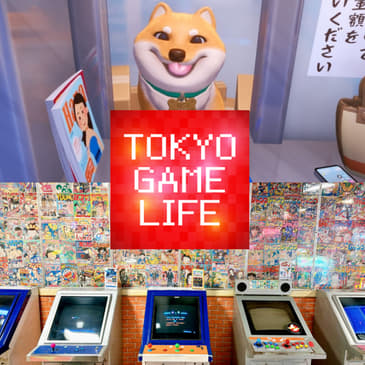
Ryan from Autumn Pioneer, the developer of Shashingo: Learn Photography With Japanese joins the podcast to talk about his photo-snapping edutainment game with a Tokyo flair! We dig into using video games to learn languages, the joy of photography games, and tons of obscure Japanese oddities. In the feature, I take you to Odaiba’s amazing retro arcade that is one of the best in all of Tokyo!
Check out Shashingo: Learn Japanese With Photography here:
https://store.steampowered.com/app/1632490/Shashingo_Learn_Japanese_with_Photography/
Follow our guest:
Official account: https://twitter.com/ShashingoGame
Ryan’s account: https://twitter.com/AutumnPioneer
(0:00) - Intro
Games
(0:53) - Shashingo: Learn Japanese With Photography w/ Ryan of Autumn Pioneer
Feature
(38:02) - Odaiba’s awesome retro arcade
News
(48:38) - Summer Games Fest
(52:02) - New Nintendo plushies
(53:01) - Closing
Social media:
Twitter: https://twitter.com/TokyoGameLife
Instagram: https://www.instagram.com/tokyogamelife/
YouTube: https://www.youtube.com/@tokyogamelife
Threads: https://www.threads.net/@tokyogamelife
Bluesky: https://bsky.app/profile/tokyogamelife.bsky.social
Website: https://tokyogamelife.com/
Like and subscribe on your favorite podcast app!
Send questions and suggestions to: tokyogamelife@gmail.com
[00:00:01] Welcome to Tokyo Game Life, a Tokyo-based video game podcast focusing on Nintendo and gaming culture in Japan's capital. Your host Mono here to bring you a slice of gaming life from Tokyo. Today, game developer Ryan from Autumn Pioneer joins as we chat about Shoshingo, Learn Japanese
[00:00:24] with Photography, a creative photostep game that helps you learn Japanese. We discuss the game's origins, what makes taking pictures in a video game so fun, and dig into the game's many Japanese-specific Easter eggs.
[00:00:36] In the future, I take you to one of the coolest retro-orchades in all of Tokyo, Odaiba's Ichome Playland. And of course, I'll end with some news. Let's start with Ryan and Shoshingo. Today in the game section we are going to take a look at Shoshingo, Learn Japanese
[00:00:56] with Photography. And by we, I mean myself and a very special guest. So guest, please introduce yourself. Hi, I'm Ryan. A lot of people I guess online know me by Autumn Pioneer, which is also the name of the company that I use to develop Shoshingo.
[00:01:13] And I'm a game developer from Sheffield in the UK. Welcome to the podcast. So give us the elevator pitch. What is Shoshingo? I guess if you can't figure it out by the long title itself, it's a game about
[00:01:28] taking photographs of things in a virtual fictional but Japanese-inspired city, like a condensed Tokyo almost. And when you take pictures of things in the game, you're given the English translation and the Japanese translation. So essentially you can make flashcards with photographs.
[00:01:53] How did you come up with the idea? Were you trying to think of a creative way to learn Japanese or did you settle on having a photography game and then you tied it into Japanese later or what? It's a mix of both I think.
[00:02:06] So originally I took part in a game jam. I'm not sure if it's still ongoing now, but every year when GDC happens, there was an online, I think it was called a non-conference. It was almost like the opposite of GDC that was called Not GDC.
[00:02:25] And it was like a Discord kind of, almost like a conference inside Discord and on a website and people would upload talks for free. And on that year that I attended, there was a game jam, which was also just online.
[00:02:41] And I think there may have been a theme for the game jam, but I'm not honestly too sure about it. I remember that I went ahead with the idea of FOMO, fear of missing out, because
[00:02:53] a lot of people want to go to GDC, but it's pretty expensive for a lot of indie developers especially. Right. And so I made a short game about taking photographs of the things in your house to then sell on an online auction platform basically.
[00:03:12] It's a little bit silly, it's a little bit depressing in a way, I suppose. So at the end of the game, your apartment is basically empty, but you have enough money to go to GDC. Oh, nice. Yeah. Kind of a meta quality to it.
[00:03:29] But from that, I created the photography mechanic and I kind of felt that it was too interesting to just leave as a game jam mechanic essentially. I wanted to make something more from it.
[00:03:43] I studied at university in Germany and when it got to the time to do my thesis project, I wrote about video games as a form of second language acquisition. I just wrote a little bit about how there's different ways you can use games to learn languages.
[00:04:03] So of course, there's some games that allow you to change the voiceline language from the subtitle language for example, or there's games that you could just play entirely in a different language. For example, you could play Animal Crossing, right?
[00:04:18] And there's so many objects and furniture and things to collect in Animal Crossing. And if you play in a different language, you could learn so much vocabulary just from buying things from the shops or picking up the items, catching bugs.
[00:04:36] And I think we are in a timeline where games have advanced so much, but like gamified education is still so, I don't want to say it, but it's boring. Right. Like we have so many opportunities to make things that are a lot more fun
[00:04:56] and more immersive for the player, but a lot of the time we just simply go with apps that are just multi-choice questions. And I wanted to learn Japanese for quite a while. I studied on and off and I wanted to create a game that would help me study.
[00:05:17] So I started creating Shishingo for my thesis project. And I think before the end of the deadline, I made like a Twitter account for it. I started sharing some updates and some videos and a few of the posts went to my standards at the time.
[00:05:36] They went a little bit viral and people said that they also wanted the game. So yeah, from there it kind of merged into a commercial project and I started to work on it a little bit more seriously.
[00:05:50] AC In Shishingo, how did you balance the gameplay elements with the learning aspect? Was there ever a time in development where you thought you were leaning more into gameplay than learning or vice versa? Or is your mantra as long as people are having fun,
[00:06:03] it's up to them to decide how much they want to learn? Yes, it's been difficult. In multiple ways, it's been difficult. I want to give people freedom to study at their own pace because it's not fun to be forced to study.
[00:06:20] But if you give players too much freedom, they often do things wrong. And if you're making an educational game, you don't want things to sort of like hinder their progress in actually learning. So the game itself is actually not very gamified, to be honest.
[00:06:42] There's some slight reward mechanics, but there's not really any pressure to always be right or to have like a time limit or anything like that. And for example, this was a pretty big challenge for me when before the Kickstarter that I did,
[00:07:04] I pitched the game to a few publishers. Now, I never really wanted to actually have a publisher because I really wanted to retain that creative control. And I honestly don't think there's many or any at all publishers that have experience
[00:07:24] with educational games like this that are kind of far from being typical games. And during a few of the meetings, a lot of them always asked me like, you know, how are you going to make it more of a game?
[00:07:40] Like, how do you keep people in the loop and keep playing? And it's always been a difficult question to answer because I want people's own motivation outside of the game to learn Japanese to be the thing that keeps them playing.
[00:07:57] And it's so difficult to find a balance between keeping people playing the game and just letting them have their freedom because it's not something... Like when you play a game, you learn the skills in the game, right?
[00:08:13] You learn how to aim better or your character learns skills that can then do something more special in the game. Shishingo is completely outside of the game. If you learn something in Shishingo, you hope that the player will then take that with them
[00:08:31] and maybe start a conversation with the Japanese person and use the words that they've learned. And it's really difficult to fit Shishingo into this, this title I suppose of a game. It's quite difficult. S. You have a favorite Japanese word in Shishingo? A. Favorite Japanese word in Shishingo?
[00:08:51] I guess I don't have one, but I know there's a small kind of funny reference to something that is very Japanese. So I'm sure you are aware, but in Japan, sometimes they sell square watermelons. S. Yes.
[00:09:06] A. And so I decided in the game to make several of the watermelon square. And of course you can learn the word tsuka for that word. S. Yes. A. And it's been quite funny watching people play the game because
[00:09:19] for example, lots of VTubers have played Shishingo on Twitch and so many of them have instantly recognized this kind of iconic Japanese square watermelon and found it really funny. But I know of a few Japanese people who have seen the game and somehow have never actually
[00:09:37] heard of square watermelons, which has been kind of funny because it's obviously from their country. S. Right. A. But as for words, there's too many, too many words. It's difficult to choose a favorite. S. These past few years, there have been a lot of photography based games, probably
[00:09:52] because people who played Pokemon Snap as a kid can now actually make games. But why do you think photography and video games are so appealing to people? A. That's a good question. I think also we may be in the era of the photography game at the moment.
[00:10:06] And I think that's because of hardware that we have now is powerful enough to capture images, screenshots, whatever, at the same time as us playing without any form of lag or disconnect from the actual game. It is definitely becoming more popular and I agree with that.
[00:10:27] And I think people are starting to find with photography games, some people don't have cameras in real life and cameras are pretty expensive as a hobby, especially if you want to get into like new lenses.
[00:10:43] And everything is just costing more and more and more to be more creative or to explore more avenues for your own photography. But you buy a game and everything is included. So for example, in Shishingo, you have like a zoom lens, which is,
[00:11:02] you know, you can take pictures that are super close and super far away. And it's really easy and you don't have to pay anything else. And in real life, it's completely different because buying a really good high quality zoom
[00:11:16] lens is going to cost a lot more than a single video game. I think like photography in games is something really special because everyone experiences almost the same view of when they're in a city in real life almost.
[00:11:34] And you know, photographers have a different eye for seeing things, but games, there's so many games now with completely different fantasy worlds. And so you could open up like the screenshot mode or the camera mode in so many different
[00:11:49] games and your options are just so much wider than having to think about where to travel in real life. And even just affording like travel, like if you want to be like a travel photographer,
[00:12:04] it's going to cost a lot of money, but you could travel to, I don't know, like a fake Tokyo and you can start to take photographs there. And it's quite free in a way. I want to talk about the design of the city.
[00:12:19] So you mentioned that it's based off of Tokyo, but is it based on a particular area of Tokyo or is it kind of an amalgamation of different places? Yes, it's a very condensed Tokyo with some areas that you might notice the inspirations from.
[00:12:35] So I suppose it's difficult to explain without the map in front of me, but there's areas that are like Akihabara, the otaku video game arcade area, and there's a small portion of that kind of fit into the corner of the map.
[00:12:50] Beside that is a reference to Omoide Yokucho. Hachiko is there in a small park that is just a reference to the real thing, of course. And there's some more high-end looking shops, which you can basically find all over Tokyo.
[00:13:09] But yeah, it's been fun designing the map, but it went through many iterations just to get something that felt natural, still looks like Japan. Because every single building in Japan looks completely different. Yes. And making games, you often need to optimize and reuse assets.
[00:13:31] And I personally felt that this was an almost impossible task for creating something that looks like Japan. I think if I remember correctly, every single building is modeled by itself because I just needed something completely different for every building.
[00:13:50] I've tried to create condensed areas of different places of Tokyo, and it's just very difficult for it to still feel like Tokyo. But lots of people have still said that they feel the exact feeling of when they go to Japan just from playing the game.
[00:14:06] So that's been really rewarding. Yeah. One thing I like about the design of the city is that it does feel both very idyllic, like what you'd imagine the perfect Japanese city to be like.
[00:14:17] But there are also a lot of things you probably wouldn't notice unless you live in Japan, where I've visited many times. For example, in the game, there's a shop called Atelier Elise. And this is a real deep cut because, listeners, there are tons of shops
[00:14:30] called Atelier all over Japan. It could be a clothing shop or a bakery, or really just anything. But Japanese companies really love the word Atelier. So that's something that was included in Shoshinko that I think a lot of people might play over their heads.
[00:14:45] So do you have a favorite subtle detail in the game? Oh, there's actually quite a few. I listen to a lot of Japanese rock music and alternative music. So there's a few references in the names of places in the game that are referencing
[00:15:02] songs from specific bands that I like. So one of them, for example, is the Cafe. The Cafe is called Avocado. And that is a reference to, I think I would say it's my favorite Japanese band. They're called Yonige. And they have a song called Avocado.
[00:15:19] It's not actually my favorite song of theirs. It's one of my favorites, but I still wanted something that kind of like matched the Cafe vibe. And I feel like Avocado is a good match for that. So there's that.
[00:15:31] There's also some subtle Easter eggs to like my family members, for example. Like there's a very large billboard that just says A and C. And that is just a reference to my brother and my sister's like first initials. Nice.
[00:15:48] Speaking of subtle everyday Japanese elements, I noticed the game uses some irasutoya. Can you explain what is irasutoya and why did you decide to incorporate it into the game? So basically it's a stock image library that is very large.
[00:16:05] And I think that it might be updated almost weekly at this point. There's almost an image for anything that you search for. And you see it used almost everywhere in Japan. I would say that you can probably find a picture of it on almost every street
[00:16:24] because they're used on like bulletin boards, on posters. Just literally everywhere in Japan you will see it. And I thought that if I'm going to find an art style that is consistent and fits with my
[00:16:42] own art style for the 3D work, that this would be the perfect match because everybody knows it or at least has possibly seen it. And maybe didn't realize it, but then they might pick up on it when they play Shishingo.
[00:16:57] I think more people are becoming aware of it. And I think for that reason, it also makes it just a little bit more fun to have in the game. Yeah. It's very authentic because I probably see it every day and you see it pretty much everywhere.
[00:17:11] If it's a local shop or even on government advertisements, because it is free and you can use it for commercial and non-commercial projects. So it is very, very prevalent. It's another really interesting touch in the game that a lot of people wouldn't know unless they've been into Japan.
[00:17:29] And about the look of the game, how did you decide on the look of the graphics? Were you trying out different art styles early on or did you already have a good idea on what you wanted it to look like from the start?
[00:17:40] So as an artist, I think it's been difficult for me to find my own style. As my journey has gone on for learning 3D art and getting into game design, game development, I've always wanted to do more 3D art.
[00:17:58] If you ask me to draw something, I cannot draw. So 3D has always been the way that I want to go with making my own games, at least recently. The style for that has probably been inspired by Nintendo games
[00:18:16] and Overwatch, which was one of the big inspirations for the art style. Not many adults seem to have played it, but there was some really nice environment art in the Plants vs Zombies Garden Warfare games. In terms of art, they are just really great 3D games.
[00:18:35] They're very stylized, but they still got that kind of realistic feel to them. If I'm going to make a photography game, I need to try my best at creating something that's visually pleasing and makes you actually want to take photographs.
[00:18:50] I know that can be achieved in many different styles, but this style was what I had come to use for my own, essentially. But honestly, if any other indie developer is listening right now,
[00:19:05] I would honestly say do not try to make a 3D, like PBR, stylized game alone. It takes so much work, and that's often why a lot of indie games, while they're still very, very stylish, you can tell that the artist itself
[00:19:28] – I don't want to word it in a way that sounds negative, because I don't mean it in a negative way – but it looks more simple, but polished. Whereas when you try to create a game in 3D in a PBR stylized style,
[00:19:42] most of the games you see, like the ones I mentioned, are made by huge teams. You've got somebody handling the lighting, you've got different texture artists, you've got the 3D modelers, etc. It can go on.
[00:19:56] You have to wear all of those hats when making a game on your own. If you can simplify the art style and still create something that looks good, you will save so much stress and so many hours.
[00:20:07] But if you do this and you create something that you actually like, it's very rewarding, but it comes with some negatives as well. A lot of people, when reviewing the game recently,
[00:20:20] have assumed that the game was made by a much larger team than it just being 99% just me, and a few freelancers that helped with two or three models in the game. It's quite a lot of pressure to put on one person.
[00:20:38] When some people review the game, they don't see humans behind the game anymore. They see it as a larger team, that somebody on the team may be failing or lacking behind. It's quite a lot of pressure for one person to do that.
[00:20:53] But at the same time, it's also a compliment, because it seems that I can produce something that people think is made by multiple people. That's not to discredit the freelancers that did work on the game with me, but proportionally most of the game was made by one person,
[00:21:12] and that's why it's difficult to deal with some comments like that. S.S. Yeah, you are the developer, artist, and game designer of Shoshingo. You are wearing a lot of hats, but you did have help with the music.
[00:21:24] Who created the music, and what kind of atmosphere were you going for with the soundtrack? A.S. So Kenya Abe is a friend that I met on a language learning app called Hello Talk. It was kind of crazy because we just became friends naturally,
[00:21:42] and I think it was like six months in that we got onto a conversation where Ken mentioned that he used to study music, and he used to compose a few songs,
[00:21:57] and kind of dropped out of it a little bit, but he kind of wanted to do a little bit more. And I was like, well, I'm making this game, and I have no music for it. And while I personally do enjoy writing music,
[00:22:12] I don't write music that would fit in any way to a game like this. And so I think we started working on a track together. I was just kind of there to give comments on what I thought could change, or the vibe that I wanted it to fit.
[00:22:31] And so the first song we made was just the main theme of the game, and we posted that, I think, on Twitter with some of the gameplay, and everybody really loved the music, which was great.
[00:22:44] And great for him because he was out of writing music for a little while, and he came back to it, and he was absolutely incredible. Every single song that he writes was just almost perfect. And I would just need to say like, oh yeah,
[00:22:59] just this one tiny thing, and we're basically good to go. The rest of the soundtrack other than the main theme was inspired by, on YouTube, and I think on Spotify and some other platforms, there's lots of playlists and live playlists of lo-fi beats,
[00:23:18] and they often write that people like study with them. So we tried to do some lo-fi beats with old traditional Japanese instruments, and I personally think that it works amazing together. And it's chill enough to just be background music while you're studying,
[00:23:39] but they're also good enough just to listen to on their own, to be honest. So you launched the game on Kickstarter last year, and fortunately it was funded. Why did you decide to go the Kickstarter route? So the Kickstarter idea came around because, as I mentioned earlier,
[00:23:56] having the meetings with publishers were not really going... They were going well, and I was offered one or two deals with some publishers, but I thought that what they could actually give me did not really warrant the price of
[00:24:12] giving a large percentage of the revenue back to them. You know, it puts a lot more work for me to do. Like I now still have to do all of the marketing and business stuff, but I think it's worth it.
[00:24:26] I've heard a lot of horror stories recently from other indie developers with their publishers, and I don't feel like right now is a good time for indie developers to sign onto publishers. You know, lots of game companies are closing down after being bought by larger companies.
[00:24:45] Indie publishers are not always fulfilling their sides of the deals, and my bank account was... I think I was on like one or two months left of being able to pay myself a salary that is technically lower than minimum wage here in the UK,
[00:25:05] and that was money that came to me from the Epic MegaGrant team. So I was lucky enough to get a MegaGrant, which I think gave me something like 10 to 12 months of development on my own, but yeah, it ran out after a while and I needed money.
[00:25:30] A few months before the Kickstarter launched, I was actually planning to do a Kickstarter anyway, but then I decided I'll try to finish the game with the little bit of money that I have left, and it just was not possible.
[00:25:44] You know, games take a lot longer than you think to make. So I came back to the Kickstarter idea and I was like, okay, I've got like a month. I'll prepare... I think I prepared like everything, like the story, the description, the video, the page,
[00:26:00] in something like three or four days maybe? And I said, okay, I'll post it on my Twitter. You can sign up for the pre-registration thing for it, and when it goes live, I'll let everyone know.
[00:26:16] It went live and there's lots of Kickstarter success stories of being funded in like one hour, two hours, things like that. And to be honest, I know from some insiders that a lot of this is actually false,
[00:26:33] and they basically have somebody waiting anyway to sort of put that money in, or a large sum of that money in, especially if it's indie games that are working with publishers who are running the campaigns for them.
[00:26:50] So the publisher will put aside some money to push the Kickstarter to that 100% thing because it gets more eyes on the project straight away and the return is just going to be higher anyway. But I just went for the very organic route and let people back the project.
[00:27:09] And I think it was after a week or maybe 10 days or something like that. Yeah, I met the goal and it was enough for me to get to where I am now. Soterios Do you have any advice for other indie
[00:27:23] devs who are thinking about putting their game up on Kickstarter? What should they know before deciding whether or not to launch a Kickstarter campaign? Stig Brodersen Yes, I would say do it. If you're thinking about going between a publisher and a Kickstarter, I would say do the Kickstarter.
[00:27:38] Because you will owe Kickstarter like 30%, but it means that you've got the funds from the start and you've already secured potential streamers, content creators, and marketing buzz just from the Kickstarter itself. So as soon as the game is out, you know that you are guaranteed
[00:28:00] the players that you've secured from the Kickstarter, which is just good in general for numbers and for, you know, maybe somebody on someone's friends list will be playing the game on launch because they already have the key from the
[00:28:14] Kickstarter. That being said, if you do not already have somewhat significant reach on other social media, you will find it incredibly hard to reach your goal. And some people do give advice to set the goal to be slightly lower than what you actually need,
[00:28:35] because with Kickstarter it's all or nothing. And most of the time if you reach that goal, you will go over by a little bit anyway. But don't put it so low that if you only reach the goal, then you will struggle to
[00:28:48] deliver on your promises because the stress of working on a game with people waiting for it like every day is quite significant. So you don't want to make that even worse if
[00:29:01] your budget is so tight and potentially it might not even be possible to make a game on such a small budget. So just be careful with how you set your goal. Make sure you have enough
[00:29:13] followers that you can get eyes on the Kickstarter as soon as it launches and be prepared to deal with stress. Speaking of marketing, the Shoshingo Twitter account had a pretty viral tweet with the text, this is the only trailer needed with a short video of the
[00:29:29] game's Shiba Inu, which was posted two days before the game came out and it got over 20,000 likes, which I believe is maybe the most for the account. Was this just very fortunate
[00:29:39] timing or did you have the idea for this tweet for a while and you were just saving it? No, this was absolutely as ridiculous as it is. I was rushing to make the game ready
[00:29:52] for everybody and I was like, okay, this feature is going to take me longer than I thought it was and for some backstory, I've been working on the game for like three and a half years
[00:30:05] at that point with some like six month break in between. But honestly speaking, it got to the point where if I had to keep working on this game any longer,
[00:30:15] I just don't think I could do it. So I forced myself to release the game at the end of February and I know it's not good practice, but I crunched like every single day for that month. And
[00:30:30] towards the end, I was like ticking off all the things that are like almost finished, finished, you know? And I was like, I do not have time to make a trailer. And you know, launching a game without a trailer is absolutely ridiculous. I don't
[00:30:43] think anybody would ever do that and I honestly don't think anyone ever has done that. But I launched Shingo without a trailer. And a few days before, I was like, I still need something
[00:30:56] because the game's not finished, but I need people to look at this game and be ready for launch. So I recorded like, I think like 20, 15 seconds, 15, 20 seconds clip of the dog in the game. And I just wrote something that I thought would, I don't know, not shock people,
[00:31:15] but it's like, you know, the game is coming. But like this is almost all I can show you. But I wrote it in a way that's positive. So I said, this is the only trailer needed.
[00:31:26] And luckily, you know, this did better than the actual trailer when I got around to actually making a trailer and yeah, 23,000 likes and 1.4 million views, which I'm not honestly too sure about how Twitter has the view count. Like if they just watch like one second or something,
[00:31:46] is that a view? I don't know. But that was the most eyes that I had on the project for the entire timeline. And it was all just, I think this took me like 10 minutes to create. And
[00:31:59] it's something weird about Twitter where every time I post something that takes me a very little amount of time, it does the best. Yes. Same here for me as well. It's really hard to know what will go viral, but you had very,
[00:32:12] very lucky timing that, oh, this tweet went mega, mega viral and then, oh, you just need to wait one or two more days and you can actually play the game. So the game has been out for a
[00:32:22] while and you said you've been watching videos of VTubers playing it. So what's something that surprised you about how people reacted to the game? KS I think, I mean, the first thing that surprised me is how the game seems to have resonated with
[00:32:37] VTuber audience and culture. Like I know a lot of the people that are into VTubers also have some interest in Japan and Japanese things, but the response from VTubers has been so
[00:32:49] positive. And I have seen so many play the game and still every week or so, even though it's been a few months since release, you'll see the odd one or two VTubers playing the game
[00:33:02] and the audience is always really supportive of the game. And it's quite nice because even though it might potentially mean less sales for me, it means that whoever is watching the streams can learn some Japanese just by watching their favorite streamers.
[00:33:18] ST I don't know if you've seen this video, but I really recommend a video from Quaid called How I Accidentally Got a World Record Learning Japanese, where he tries to speed run the game without knowing any Japanese except for the words he learned through Shoshingo.
[00:33:32] And obviously you'd expect the record to be held by somebody who kind of knew all the words already, but he really does start from scratch. So it's a pretty interesting video. Do you have any tips for speedrunners interested in Shoshingo?
[00:33:44] KS I'm pretty sure I've watched that video in full. I think as soon as it came out, somebody shared it in the discord and it was really interesting to see. Yeah, people started to speed run the game, which is kind of funny.
[00:33:58] You know, people can speed run anything, but mostly it's like platformer games and things that have more set challenges. Shoshingo is so free that there's not really an end or like a end of a level. So it's been really funny to see people speed run the game.
[00:34:15] In terms of tips for speed running it, I know that some people in the discord have already figured out a specific route for taking pictures of everything that can unlock all of the hidden
[00:34:28] borders in the game. In case people didn't know, there's some specific words in the game that if you master it by getting it correct in the quiz several times in a row, you can unlock a specific border that you can place around the photograph. Even though I'm the
[00:34:46] developer of the game, I often forget how many there are. I think there might be somewhere between eight and 15 to unlock. And that is one of the categories for speed running to unlock all of those hidden borders, which is quite fun to see.
[00:35:03] KS Final question. Now my podcast is very Nintendo centric and a lot of Nintendo fans listen to it. So I have to port back a bit. Can you give us an estimated release date for the Switch version? I can't. Sorry, I had to ask.
[00:35:18] So I'm trying the current plan is to get version 1.1 out on Steam so that everything can be ironed out for what would essentially be version one on Switch. It's not that the Steam version was like an early access or anything like that. It's just that the process
[00:35:39] for updating games on platforms is a lot more complicated and takes a lot more time than just pressing a button on Steam. So I wanted to make sure that most of the features that
[00:35:55] make the quality of the game just a little bit more ready on Switch by making sure it's finalized on the Steam version first. And I really appreciate people waiting what feels like so long for the game on Switch, but I want to make sure it's right.
[00:36:18] And Steam right now is the place that I can make sure things are right before I submit it to Nintendo. Obviously, I can't talk about the process that Nintendo do because it's all very
[00:36:32] strict and behind NDA. But yes, it takes a lot longer than publishing a game on Steam. So I'm glad that people are patient. I'm working on it every day to try to get this game ready on Switch. There's still a few more things, but if everything goes well,
[00:36:50] it should hopefully be within the next few months. But I can't promise that because some things are on Nintendo's side and if they spot something that needs changing, then I will have to make those changes. And for now, that means I cannot set a date.
[00:37:08] CB Well, I'm sure many Switch fans will be looking forward to it. So that was our look at Shoshingo Learned Japanese with Photography. So Ryan, where can people find you and where can people find Shoshingo?
[00:37:21] RL So right now you can find it on Steam. I also have social media channels for my personal company account at Autumn Pioneer. And you can find the game on Twitter or X
[00:37:35] at Shoshingo Game. We also do have TikTok, but it's not really used very often to be honest. CB Great. And the links to everything will be in the podcast description. So listeners, check it out. Ryan of Autumn Pioneer, once again, thanks for joining me.
[00:37:50] RL Yes. Thank you so much for having me. It's been a really fun experience as my first podcast. RL Today's feature is on one of the coolest retro arcades in all of Tokyo, Ichome Playland. Written as One-Chome Playland, but the Japanese
[00:38:10] name is Goraku Sentai Icho, so there's quite a disparity between the English and Japanese name. And I've seen the English name written with Playland as one word, Ichome with a hyphen and without a hyphen. So honestly, for SEO purposes,
[00:38:23] I would just put Odaiba's awesome retro arcade in the title or something. But as you can guess, it's a retro arcade filled with games of yore. However, unlike a lot of other retro specific arcades or chain arcades with a few retro
[00:38:35] games scattered about, it really leans into the concept of late Showa era, general Heisei era culture and aesthetics. And it features a lot of games you likely won't find elsewhere. Ironically, I don't think this arcade is super well known since a lot of people in
[00:38:48] the arcade scene in Tokyo probably gravitate to some of the more serious hardcore games you'd find at like Makato or Hei, things like fighting games or shmups. Some of those are here, but Playland definitely leans more on gimmick cabs and analog style games like the Degashia
[00:39:04] Game Museum which I talked about last year. It's located in Odaiba, an incredibly popular tourist and shopping area in Tokyo. The place in general has a pretty interesting history. Odaiba is actually a man-made island in Tokyo Bay. Originally it was created in the 1800s as a
[00:39:19] defense against naval attacks. Imagine if you were in the 1800s and someone says, hey make an island. I honestly wouldn't know where to start. In the 90s it was redeveloped into a futuristic shopping and residential area complete with a lot of uniquely detailed
[00:39:32] buildings like the Fuji TV headquarters and Tokyo Big Sight which is one of the largest exhibition centers in Japan. Alongside those buildings are gigantic shopping complexes often with one-of-a-kind shops and attractions. There's Diver City which has the big Gundam in
[00:39:45] front of it and Gundam Base which is the biggest Gundam store in Japan. Aqua City which has a movie theater and even a Toys R Us inside, and formerly Venus Fort which was like this European-styled city inside a building. They closed that down but it was replaced by
[00:39:59] Immersive Fort which is an indoor immersive theme park. I honestly have no idea what that means but looking at the website it seems like a lot of escape room-esque games and activities. Is this secretly the greatest thing ever? Has it flown completely under my radar?
[00:40:14] I'll check it out one day. But nevertheless today we are going to go to Dex, another massive shopping complex in Odaiba. It's perhaps most famous for Joyopolis, another indoor theme park run by Sega and the Takoyaki Museum which is a food court with a bunch of Takoyaki stalls.
[00:40:29] But on the same floor as the Takoyaki Museum is Shoa Street, a narrow area themed after Japan's Shoa era, aka the 1920s to the 1980s. A long time span I know but people mostly think
[00:40:40] about the 60s to 80s when they hear the word Shoa, especially when it comes to retro Shoa. The street has a lot of old school shops but also many that seemingly have nothing
[00:40:49] to do with the time period so they're not forcing shops to comply. But the hallway is wonderfully decorated with banners and lanterns, a fake Tokyo Tower, and the elevators are inside a fake Shoa station complete with a Shinkansen bursting through the wall. But the
[00:41:03] place you should be checking out is the aforementioned Ichome Playland. It's very easy to spot due to the large rainbow banner and small K-truck at the entrance. The place is exploding with color, decorations, and weird objects so you can't help but be drawn in when you see it.
[00:41:17] The arcade doesn't have those sterile walls with cracks in the drywall nor does it look like the inside of some industrial warehouse. It has so many decorations and artwork all over the walls. The walls are filled with gigantic posters of Shoa and early Heisei era
[00:41:30] icons. Huge posters of Amisuzuki, Shinaringo, even Hapatai aka the Yattagais. There's a poster for Season 1 of the Pokemon anime and old Shonen Jump comic covers cover the entire walls of the arcade. If you're into this era of Japanese pop culture it's a huge trip down memory lane.
[00:41:48] And that's the whole gimmick of the arcade. It's not contained with just old video games but instead mashing all sorts of pop culture from the era into this one arcade. There's a display case for old snacks including a can featuring the one and only
[00:42:00] Pepsi Man. There's also a Cosmos machine which was like a proto-Gacha figure that came in a box instead of capsules. But you're not going to go to the arcade just to look around, you probably want to play some games right? The games here are not comprehensive by any
[00:42:13] means. I mean there's no Pac-Man or Street Fighter 2 but the ones that are here are all interesting stuff you likely wouldn't find in other arcades because it's just too weird or has difficult upkeep. For example Arm Champs 2 from Jalico which is yes an arm wrestling arcade
[00:42:29] game. There's a screen and instead of a joystick and buttons there's a giant plastic arm along with pads where the hands slam down. You select your opponent then arm wrestle. No gimmick, no strategy, it's strength versus strength. But again you are facing a robot so it's not
[00:42:44] exactly a fair fight. I do recommend trying it out just to see how strange it is. Another odd Jalico machine is Captain Flag where the TV is a pirate's face.
[00:42:55] Like it's inside a physical body inside the cab and the TV serves as its head. It holds two flags and the game is you raising and lowering the flags with joysticks based on the pirate's
[00:43:05] instruction. So yes just like that Mario Party mini-game. I do love the idea that there is a physical body but a digital face. Right next to that is Abnormal Check from Namco. While
[00:43:16] there's no giant arm sticking out of this one it's decorated with a bunch of weird dolls and bikinis. It's a quiz game where you press A or B and then it tells you what your personality
[00:43:25] is. There's a lot of quiz arcade games but this one stands apart with this totally bizarre aesthetic. Again it has a cab that is immediately going to catch your eye which is basically the thesis statement for this entire place. Some other fun cabs include Namco's Botan Hayaoshi
[00:43:38] Senshuken or Speed Button Pressing Championship. You need to press a button at a certain point and if you're the fastest your opponent's hand will be smashed with a plastic hammer. So there's a big plastic hammer ominously right in the middle of the cab. Right next to that is
[00:43:54] Sega Moto Polo which is kind of a foosball or air hockey like game but you control a little guy on a motorcycle. I saw someone play this and it seemed quite difficult but it was basically
[00:44:04] Rocket League before Rocket League if you think about it. Again these are games I've never seen at other arcades here in Japan. I just really love these types of Gimmicky arcade games because you immediately want to play them with others. There's been a lot of discussion about
[00:44:17] the state of Japanese arcades and how crane games are dominating arcades these days but that's largely because it's more of a physical analog experience that anyone can play. People aren't just casually plopping in some coins to play Tekken 7. These Gimmicky cabs
[00:44:31] didn't make a ton of money back in the day and were probably a pain to upkeep but I do think that ironically they are more appealing than a lot of your traditional arcade video
[00:44:39] games since they offer an experience you can't get at home these days. So yes put this hammer game on the first floor of every Gigo and Taito station and just watch the money pour in but
[00:44:49] if you are here for the real deal video games there are some classics in here. On the back wall are a few small standing cabs which include listen up Nintendo fans the original Mario Brothers and also versus Super Mario Brothers. This section is dedicated to
[00:45:03] 80s arcade games and it can be a bit hit and miss in terms of what's working and what's not. Virtua Cop 2 is also here which is another title I just have to play every time I come across it.
[00:45:12] Though I've always been more of a time crisis fan to be honest and you can also play House of the Dead right next to it. There's also a sit-down cab area with Outrunners, Jurassic Park,
[00:45:21] and yes Namco's Tokyo Wars one of my personal favorite arcade games. It's basically a team deathmatch game where you control a tank and you can switch between first and third person.
[00:45:31] Sounds easy but it's just so fun to play. I really want to cover on the podcast in the future because it's just pure simple arcade fun. I really wish Namco would just release it on
[00:45:41] consoles but I do fear that it wouldn't be the same. You do really want to sit in the chair. Okay going back to the analog games a bit since they definitely outnumber the video games there's a pinball section including multiple Star Wars pinball machines and even the
[00:45:54] Goatleab Super Mario Brothers pinball game. Sadly this was broken the last time it went but it was very cool to see in person. I played both the Star Wars games and they
[00:46:02] are neat but honestly I'm not a pinball expert nor do I know how to be good at them but I just like to see things light up and hear the Star Wars theme so A plus in my book.
[00:46:12] I would say a significant section of the arcade is dedicated to analog arcade games which I talked about in detail on my episode on the Degashia Game Museum. I seriously can't list all of them here because there are dozens but I'll tell you about some of my favorites.
[00:46:25] There's one from Sega called Moto Champ. When do you think this game was made? 1990? 1980? Try 1973. So this is a real deal pre-video game arcade game from Sega. Inside the cab is a white road with six racers and you control one of the racers.
[00:46:43] You can easily tell which one is yours because it has a huge stick attached to it. When you start the game an image of a moving road is projected onto the white sheet and all the racers move around. You have to steer with the motorcycles,
[00:46:54] uh I guess they're called steering wheels? The handles. You know what I mean. You move left and right. And you can speed up or slow down. It's quite impressive how it works since it does capture the illusion of these little figures racing each other. I will say
[00:47:07] that it's quite unfair since you will be knocked back by your opponents if they even barely touch you and they would definitely just slap against you any chance they get. But it's a very cool peek into games of this era and the unique technology they used.
[00:47:20] One type of game I didn't know a whole lot about were what essentially are more complex gacha games. Inside the cab is a gacha capsule and you have to play a little game to get it.
[00:47:30] Nenko had several of them including capsule golf and capsule soccer. I played capsule golf where you tee up a capsule and then you have to hit it into a moving hole. And listeners, I got it in one shot. The toy was a little rubber giraffe which probably cost
[00:47:44] less than one yen to make but I still got it. I think I should wrap up but I really can just go on and on about all the very specific and creative arcade games I came across
[00:47:53] and all the wild decorations. There's a Sailor Moon bingo game. There's a Crispus Tree with Dragon Ball Z pest sticks. There's a bowling, skeeball game with Mario, Goku, and Michael Jackson toys on top of it. Astro Boy is flying around on the ceiling. There's no shortage
[00:48:08] of photo ops here. I will say in terms of retro arcades in Tokyo, it's hard to beat Mikado in terms of video games but if you want a mix of different types of games from Japan's early arcade history along with a bunch of strange ones, Ichime Playland and
[00:48:20] Odaiba is definitely worth checking out. And the great thing about it is that it's not really out of the way. There's a ton to see and do in Odaiba so if you ever make your way out there,
[00:48:28] be sure to check this place out. That's it for the feature now for some news. All right, a ton of games were announced. Am I going to go over all of them here? No,
[00:48:42] sorry. If you only watch one game show though, I highly recommend The Day of the Devs stream. There were a few standouts on that such as Pedal Runner which looks like a very Pokemon inspired adventure game where you ride a bike in a city delivering pets.
[00:48:55] We also finally got an update on UFO 50 which is coming out in September, for real. I can't believe it came out before Silksong. There was also Wild Waiting, an almost WarioWare-esque absurd concept where you simply wait for things but can also cause havoc while doing so.
[00:49:09] I can't remember if this was that Day of the Devs or not but also Karn caught my interest. It's a game where you climb a mountain where the climbing mechanic is quite involved. I do love this concept for a game since I'm a big fan of the climbing
[00:49:20] in Breath of the Wild. I still need to check out Jussaint as well. It does feel like people also liked the climbing and stamina management of Breath of the Wild and also want to try their
[00:49:29] spin on it. Other games, I think the most surprising announcement was probably Lego Horizon Adventures. This was leaked a while ago but the big deal is that it's also coming to Nintendo Switch. So you can now play as Aloy in two Switch games, Fortnite and this.
[00:49:44] I'm not a big Lego game guy. I enjoyed that first Star Wars game since it was an interesting novelty and every now and then I'll try one out but I just can't get into them.
[00:49:53] But this is such a funny thing to make. I know there is already a Lego Horizon set which does make me wonder if any property that has ever had a Lego crossover could also have
[00:50:03] a game. Lego Dune Game? Lego Seinfeld? It's more likely than you think. Xbox's Showcase is also pretty impressive in that yes, a lot of games are coming out one day on Xbox.
[00:50:14] If you're a Nintendo fan, obviously your eyebrows arched at Perfect Dark, a game we haven't seen in quite a while. I think it looks solid. It leans more into the spy elements and the map exploration
[00:50:24] like you would see in Hitman or Dishonored. It does make me wonder if there will be a multiplayer component in it at all. To me, that is Perfect Dark's legacy, a creative refinement of the excellent Goldeneye multiplayer formula. But yes,
[00:50:36] multiplayer has come a long way or at least gone down a different path than what it was when Perfect Dark came out. I wouldn't hate a single player only Perfect Dark experience where you're a spy using gadgets and getting into an occasional gunfight,
[00:50:48] but I am curious to see if the devs are even going to attempt to make some multiplayer mode just because they are aware of the old heads that love the original game mostly for that.
[00:50:56] Oh, and this is technically pre-Summer Games Fest, but it aired like a day before my previous episode, but Sony showed off Astro Bot, a real deal fully fledged 3D platformer. I quite enjoyed the packing game on the PS5, and everyone's immediate reaction to that was,
[00:51:10] hey, make a full game. And they are doing just that. I would say Astro Bot definitely leans more on the Kirby side of things, focusing on power-ups and action instead of the more twitch and precise platforming of Mario.
[00:51:22] Some people who are more Mario minded might be surprised by that if they jumped into this game. But one of Astro Bot's greatest strengths is the sheer production value. This is a game that looks like it belongs on the PS5, and a lot of other 3D platformers
[00:51:35] couldn't dream of having a budget this high. I mean, outside of Nintendo, no one is really putting out big budget 3D platformers out there, and even Nintendo doesn't do it that frequently. The PlayStation nostalgia is also a very fun element. I loved collecting all the old Sony
[00:51:48] hardware in Playroom, and the celebration of Sony's hardware history does feel very Smash Bros.-esque in a way. Due to my life situation, it is kind of hard for me to just
[00:51:57] sit down and play my PS5, but I would definitely try to make some time for Astro Bot. Alright, let's close out with some important plushy news from Sony. Moss from Pikmin 4 is scheduled to hit later this June. So if you have Ochi,
[00:52:10] you can now also have Moss. Also late in June comes Luigi with the Poltergust and Polterpup to line up with Luigi's Mansion 2. You might be wondering why are we getting Moss now but Luigi gets his plushy ASAP? Well, these are actually re-releases of
[00:52:24] the original plushies when the game originally came out. So yes, they are re-mastering plushies. We've reached that point on the timeline. But the latest announcement is that there will be new Princess Peach Showtime plushies in the middle of August. These feature Peach with Stella
[00:52:38] and Swordfighter Peach, which I imagine will be a popular pickup. Swordfighter was probably my least favorite costume change but it is perhaps the most visually striking. I also can't remember if I mentioned this on the podcast yet but the Hobonichi Mother Project
[00:52:51] is also selling new plushies of two members from the Runaway 5 on their website as well. It's been a huge year for Nintendo plushies and we're only halfway through. On that note, let's wrap up. Thanks as always for listening. Be sure to like and subscribe
[00:53:04] to this podcast on your favorite app. Leave a five-star review as well, it really helps with visibility. This podcast is also available on YouTube so like and subscribe there as well. I'm on Twitter, threads, blue sky, Instagram. Just search for Tokyo Game Life or find the
[00:53:17] links in the podcast description. If you like the podcast be sure to share with your friends and on social media. If there's anything you want me to talk about or cover, don't be shy,
[00:53:25] just message me on Twitter. The next episode will be on June 30th. See you next time. Matane!