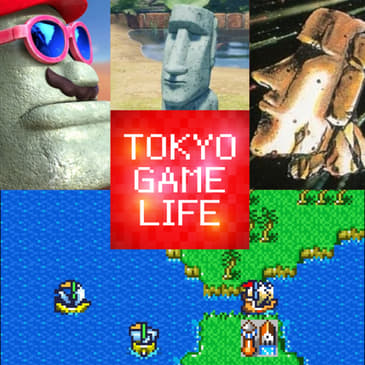
What’s up with moai in video games? You’re gonna find out as game developer and creator of moai.games joins as we chat about moai in Japanese games! We explore Japan’s fascination with these mysterious statues, why Konami loves them so much, and reveal our favorite moai! Plus I take a look at Koei’s ambitious strategy game Uncharted Waters: New Horizons before closing out with some Japan-focused Switch 2 news!
Follow our guest!
Website: https://www.gingerbeardman.com/
Moai website: https://moai.games/
Itch.io: https://gingerbeardman.itch.io/
YOYOZO: https://blog.gingerbeardman.com/2023/11/21/yoyozo-how-i-made-a-playdate-game-in-39kb/
Emoji history: https://blog.gingerbeardman.com/2024/05/10/emoji-history-the-missing-years/
(0:00) - Intro
Feature
(0:54) - Moai in Japanese games w/ Matt Sephton
Games
(30:50) - Uncharted Waters: New Horizons
News
(36:45) - Mario Kart World Direct, Switch 2 preorders in Japan
Social media:
Bluesky: https://bsky.app/profile/tokyogamelife.bsky.social
Twitter: https://twitter.com/TokyoGameLife
YouTube: https://www.youtube.com/@tokyogamelife
Instagram: https://www.instagram.com/tokyogamelife/
Threads: https://www.threads.net/@tokyogamelife
Website: https://tokyogamelife.com/
Like and subscribe on your favorite podcast app!
[00:00:07] Welcome to Tokyo Game Life, a Tokyo-based video game podcast focusing on Nintendo and gaming culture in Japan's capital. Your host Mono here to bring you a slice of gaming life from Tokyo. Game developer Matt Sephton joins as we chat about Moai in Japanese Games and his fantastic website that catalogs every Moai in a video game. We explore the relationship between these mysterious structures and video games, our favorite games with Moai, and get into Japan's fascination with this cultural landmark.
[00:00:37] In the game section, I take a look at Koei's swashbuckler Uncharted Waters New Horizons, plus a whole lot of Switch 2 news. Let's get into the feature on Moai in Japanese Games with Matt Sephton. Today's feature is all about Moai in Japanese Games. Trust me, there's a lot more to talk about than you think, and we're also going to dive into Japan's fascinating obsession with this cultural landmark.
[00:01:04] Joining me to chat all about Moai and more is a special guest. So guest, please introduce yourself. Hi there. My name is Matt Sephton. I run the Moai Games website and do a bunch of independent video game developing as well. Thanks for joining me. Just in case there's one person out there who's been living under a rock and doesn't know about these rocks, tell us what are Moai?
[00:01:27] Moai are monolithic structures present on Easter Island, but these days they're everywhere. They're even in emoji. I think perhaps most people are familiar with them, but maybe not. Yeah, I would hope all my listeners are familiar with Moai, but just in case there's maybe one straggler out there, there's an adult who suddenly learned about the existence of Moai. It would be a great day for them. Absolutely.
[00:01:51] But I would say it's definitely in the upper tier of notable human creations, both in their design and in our modern world. Like you said, it's easily the inspiration for one of the best emoji. You can really just drop that emoji in any situation and it will make an impact. Now, there are a lot of people who know about Moai, but in terms of Moai in video games, you are definitely at the top because you are the creator of the amazing catalog website, Moai.games. For those unaware, tell us what is this website and what inspired you to create it?
[00:02:20] So this website is a catalog of screenshots of any game that features a Moai. It's been online for a few years now. I think it was a rainy day that was the catalyst for it, but I've been collecting screenshots of Moai for a while before that.
[00:02:36] And I was aware that there were other people talking about it online. And I thought that maybe I could quickly put together a WordPress website that allowed me to collate all of the screenshots so far in one place. At that time, I was doing some web development. So it was quite a quick process to put them together. Entering the data took by far the longest time to upload the screenshots and add the labels and all the metadata for developers.
[00:03:06] Because with the website, you can search by developer, by platform, by game title, by year. I thought that kind of searchable database was a fun thing to do. Yeah, it's one of those projects where once you see it, you think, man, I'm glad somebody did this. This is probably a shower thought for most people, but you really turned it into a valuable resource.
[00:03:27] And I would say it's a pretty notable website that a lot of people are aware of. And it's been covered by various media, including, I guess, my podcast right now. So were you surprised about just how popular the website became? Yeah, I was. Initially, it started small, and then it progressed from there. So, you know, I think the thing that inspires me is that it's still, multiple years later, receiving weekly attention.
[00:03:53] The biggest event was probably the 1,000-game landmark that was passed earlier this year. That kind of struck me. I remember when the 200 landmark was a big event, and now there we are, 1,000 in the bank. Like, it's kind of a testament to the community that submits screenshots, as well as me, that it's made it this far, no question about it. But the attention it's received, and a little bit of press it's received, it just keeps the fires burning, you know?
[00:04:20] Okay, let's start digging into some games. We probably don't have enough time to get into 1,000 games, but we can get into at least a few of them. So, the first Moai to ever appear in a game, what was it? So, it's debatable, but it's definitely from the year 1983. It was either The Mystery of the Moo Continent, which was a game by Magical Zoo for the FM7, MSX, and Sharp X1,
[00:04:47] or The Secret of Easter Island by an American guy, Jeff Marancini for the Apple II, but that was distributed worldwide. There's also an arcade game, Exerion, by Jalico 1983. That was on arcade first. It's difficult to really find release dates for anything quite that old, you know, especially in the kind of pre-internet age. I've managed to find a few snippets.
[00:05:15] I am in touch with the American guy about his game. I like to think that the first one was The Mystery of the Moo Continent because it's such a unique-looking game. And there is a lot of press about it in vintage Japanese magazines, so I firmly believe that that was the first. Yeah, you have four games listed for 1983, and three of them are from Japanese developers. And I thought I could maybe find out the release dates for them if I used my Japanese language powers and the power of Google. But I couldn't find a definitive answer.
[00:05:45] There's not a lot of cataloging in terms of all the magical zoo games out there. But for you, do you remember the first time you saw a moa in a video game? Well, I'm not sure I do, to be honest. I can definitely remember the one that stands out the most. I've been gaming since the mid-80s, so I've been gaming for a long time now. So I can't really remember the first one. But the one that stands out the most is undoubtedly the Gradius series of shoot-'em-ups from Konami.
[00:06:11] We had a magazine, and I'm from the UK, so we had a magazine called Superplay, which was a Super Nintendo magazine that specialized in its coverage of import games from Japan. And I remember seeing screenshots of Gradius in there and thinking, wow, what is this? What are these things? What is going on in this game? So that's the one that stands out for me, really. Yeah, I think that's probably one of the more notable ones.
[00:06:36] So we'll definitely get into Gradius and also the company that develops it, because they are definitely the most moai crazy. And an early one that stuck out for me is Kabu from Kirby. And it's not exactly like a moai, but that's an obvious inspiration for it. And I always thought it was just a weird thing to fight, especially since it doesn't have any real attack. It just kind of spins at you.
[00:06:56] And ironically, there is a type of block in one of the Kirby games that looks exactly like Kabu, and it's just called moai block, which does kind of open up a can of worms in terms of whether or not Easter Island is canonical to the Kirby universe. But in terms of developers who put moai in games, there's definitely a lot at Nintendo and definitely a lot at HAL, but I would say Konami is number one, at least in terms of your website. So what's the obsession with moai at Konami?
[00:07:23] Konami is interesting because it kind of goes back to a developer who worked there, Yoshinori Moai Sasaki. And Moai was his nickname because he was, and I hope it's okay to say this, he was a huge block of a man. You know, he was just probably six foot six tall and built a match. Visually, he's reminiscent of a moai, if that makes sense.
[00:07:50] So, you know, it makes sense to me that that was his nickname at Konami. From that nickname, I guess the rest of Konami's moai inclusion stemmed. Yeah, I looked up Moai Sasaki and I can't lie, he does look like a moai. I understand why he has that nickname. I don't know if I would be good natured if somebody told me I look like a moai, but he seems like he really embraced it considering there are moai in so many Konami games, literally dozens of games.
[00:08:20] And so do you have a favorite Konami moai? So yeah, my favorite Konami moai is one that I'd heard a little bit about, but I had to actually play the game and capture a screenshot myself to record it for the website. And that is Winning Soccer, Winning Eleven, also called Goldstorm in some regions. And that's from 1996 in the original PlayStation.
[00:08:44] And it's a cheat in that game that allows you to change all the players' heads to moai. So it's kind of a fun one. And I took a great screenshot of a gold celebration with multiple players running towards the camera, all with the head and kind of body color of a moai. Yeah, I was looking through the list for Konami, and it's pretty amazing how a moai has appeared in pretty much every Konami franchise. It's in Metal Gear. It's in Castlevania. It's in their soccer games.
[00:09:14] It's in their baseball games. It's in Yu-Gi-Oh! So it is almost sort of like a secondary mascot of Konami that I think a lot of people maybe don't think about. I think if Konami ever wants to buff up their goodwill, they should just change their logo to a moai. I think that would definitely help a whole lot. What would you say is the most surprising game that has a moai statue in it? I guess the soccer game is probably high up there, but is there one that even beats that one? I mean, with Konami, it's really interesting because
[00:09:42] even if they're just the publisher and the game isn't developed by Konami, you can pretty much bet that there'll be one in there. I remember when Apple Arcade released, there was a Konami game developed by Q Games, I think it is, and it's a Frogger game. And I just had a hunch that there would be a moai in there, and I played it, and it took me multiple hours, but there it was, hidden to one side in one of the levels.
[00:10:10] So I think they're a safe bet, really. But in terms of surprising moai, I think they're the ones where, you know, the game isn't set in anywhere where it makes sense for a moai to exist. You know, it's not a desert island. It's not a real world location. But it might sneak up as a little hidden bonus or something that makes kind of no sense in terms of the concept of the game.
[00:10:39] And that's kind of how I like to include them in my own games as well. Yeah, for me, in terms of most surprising, I haven't seen all 1000 games yet, so I can't give a definitive answer. But going back to Konami, they made an arcade game based on Aliens, the 1986 movie. And shockingly, there is a moai statue present on a poster in the background of the game, something I don't think was in the movie at all. So that goes to show you how often they just try to shoehorn a moai statue into any sort of game, even if they're making one based off a James Cameron movie.
[00:11:09] So let's talk about our favorites. What are some of your all-time favorite moai statues in a video game? So we've already talked about the Konami Sokka moai. So that's my number one because it just looks so cool. But I think some of my other favorites are playable moai. I really like playable moai. So you can play as a moai. So I'm trying to think of an example there.
[00:11:36] I think Konami did a Game Boy Advance racing game where you can play as a moai, like a character. So that's pretty cool. You can fight moai. You know, there's a Konami game. I only know the Western title. It's called Monster Maulers. And with that one, there's kind of a double moai. So you've got an enemy that you fight as the head of a moai, but there's also a stage in the background that's kind of full of moai.
[00:12:05] So that's another one of my favorites because that's kind of like moai overload. I'm a big Pokemon fan. So I have to give a shout out to Nosepass, who is kind of an interesting hybrid between a moai and also a compass. And his evolution Probopass highlights some of the more obscure types of moai because Probopass has a hat on. And this is modeled after the Pukal hat that some moai have. So somebody at Game Freak did a lot of research on moai to make this very accurate.
[00:12:33] And I think a moai is in pretty much every WarioWare game in some capacity. And again, it is pretty wild how many moai appear in just Nintendo games alone. WarioWare, Mario, Pokemon, Animal Crossing, Splatoon, even Zelda all have moai in them somewhere. So let's get to the bottom of this. We know that moai in Konami games are likely inspired by moai Sasaki, but I don't think all these other moai are just riffs on him.
[00:13:01] Do you have any theories on why there are just so many moai in games, especially Japanese games? My opinion is that it's kind of twofold. One is that they're quite a mysterious thing that is perhaps unexpected and will kind of make you sit up and take notice when you encounter them in the game. But I think more than that, particularly in Japan, oai kind of permeates culture. You know, you've got the moai statue in Tokyo.
[00:13:27] That was installed, according to my notes anyway, in September of 1980. But even before that, there was an expo in Osaka, Expo 70. And there was a moai there. And as far as I'm aware, that was kind of the first time that the Japanese public had seen a moai of close and personal were able to, you know, stand next to it at the expo.
[00:13:53] So I think from 1970, when that was in Osaka, 1980, a moai replica introduced in Tokyo. There was an expo land in 1982, also in Osaka at the same location. And that had a real moai on display. And I think from that point on in 1982, it's, you know, given that we've already discussed
[00:14:17] that the first game was in 1983, I think it makes sense that those events were to kind of led up to the moai craze in video games. Yeah, I think one aspect from a technical perspective, it is very easy to portray moai in 8-bit graphics, for example. They're not very detailed, but they have a very particular and recognizable shape. So even games with rudimentary graphics could portray one. Like there's a moai in the background of Super Mario Land on Game Boy, for example.
[00:14:45] But Japan definitely has a very long history of fascination with the moai and Easter Island, which is called Rapa Nui in the indigenous language. We should shout that out. And now it's the history lesson portion of the episode. Did you know that in 1937, Chile, who has Easter Island, they were in negotiations to sell Easter Island to Japan? Did you know that? To sell the whole island. Wow. I did not know that. Wow. That is unbelievable. Yes.
[00:15:12] Chile was strapped for cash and they thought, well, we don't need this island, which is kind of ironic now, since I have to assume it brings in quite a lot of money from tourism. And they were in negotiations with Japan to sell the island. But after a few months, Japan said no, mostly because it didn't have any kind of strategic element to it. And also they thought they would kind of upset America if they were that close. And yeah, this is in the imperial days of Japan. So they were at least humoring some land grabs, but it didn't go through.
[00:15:42] So Chile still has Easter Island. But that is like maybe one of the earliest connections between Easter Island and Japan. But for the general public, I think many became aware of Moai through the Japanese translation of Aku Aku, a book detailing an expedition to Easter Island in 1958. And you mentioned before in the 70s in Osaka, there was an expedition. And also in the 70s, there was a documentary called Mirai Eno Isan, which heavily featured the Moai as well.
[00:16:09] By the way, have you actually ever seen a real life Moai statue in real life? Yeah, I have. There is one. I think there's actually more than one at the British Museum in London. It's not always on display. At least one of them in particular is in quite poor condition and is often of view. But the main one that they have is out most of the time. And I've been there. I have mixed feelings about seeing that in the museum. You know, you mentioned Rapa Nui being the indigenous name for Easter Island.
[00:16:37] And I kind of have mixed feelings about everything I see in museums, really. Right. So I don't really want to go into politics. But it was quite overwhelming to see that statue in person. Pretty majestic thing. Yeah, I haven't seen one in real life yet. But yeah, I'm surprised there is actually just one sitting there in Britain. So you are closer to one than I am.
[00:16:58] But going back to Japan, one of the more direct links between Easter Island and Japan happened in the 90s, where Chile suffered a major earthquake that toppled a lot of the Moai statues. And the governor of Easter Island appeared in a documentary on Japanese TV talking about if they had equipment, they could rescue the statues. And just by happenstance, somebody who saw the documentary in Japan, he worked for Tadano, which is a construction crane company.
[00:17:24] And then that company, they created the Moai Restoration Committee to help rescue the Moai in Chile. And it took a few years, but the Moai that were toppled over from the earthquake were saved. And thanks to that, Chile created seven replica Moai and then sent them to Japan, where they now stand at the San Mese Nichinan Park in Miyazaki Prefecture. So these are not real Moai, but they are made in Chile, at least, and they were shipped to Japan.
[00:17:52] So these are the closest, I guess, quote unquote, real deal Moai you can see in Japan. So is visiting this park on your bucket list at all? It is. I've seen photos of that park, actually. And I've seen some other replica Moai dotted around Japan. Definitely something that I'd like to do. I've only been to Japan once before, and that was about 20 years ago now. So I think I'm overdue another visit. Oh, yeah. Yeah, Miyazaki Prefecture is pretty far away from me. But if I ever find myself down there, I'll try to check it out.
[00:18:21] But there are indeed faux Moai, or maybe they should be called faux-ai, in Tokyo. Nijima Island, which is technically in Tokyo, was one of the Izu Island chains. They gifted a Moai statue to Shibuya, which you mentioned before, in 1980. And it's still there today. Not quite as popular as Hachiko, in terms of let's go there and see it. But it's still there. And the statue is specifically called Mo-yai in Japanese.
[00:18:46] Since in the Nijima dialect, it refers to cooperation and community. And going back to emoji, the Unicode name for the Moai emoji is Moyai. So there's been some speculation that the emoji is actually not the Easter Island statues, but it's the Shibuya statue. Although it doesn't really look the same to me, but maybe it's hard to tell because it's just an emoji. But there are quite a few statues in Tokyo. Like in Shibuya, there's some other statues at Kamata Station.
[00:19:16] And also Odaiba as well. So you can definitely go on a Moai scavenger hunt in Tokyo. Just to go back to your point there about the emoji, that's really interesting. I also run a blog. And one of my most popular blog posts is when I discovered, by pure chance, the earliest set of emoji on a Japanese PDA or personal organizer. But the Sharp PI 4000 personal organizer from Japan, and that was released in 1994.
[00:19:44] And as I was kind of using it and scrolling through its functions and features, I stumbled across a whole character set of emoji. And it didn't really make sense to me because the common or the kind of repeated timeline of emoji was that they didn't get invented until the late 90s. So for me to see them on this device that was released in 1994 kind of spooked me a little bit.
[00:20:08] And I did a little bit of research and eventually found an older organizer from 1988 that features the same character sets or pretty much the same character set of emoji. They don't include Moai, unfortunately, but they do show the origin of emoji. And obviously that's a Japanese thing.
[00:20:29] So I think when Moai was included in the emoji set, it made sense for it to be about the Shibuya statue that people might want to use an emoji to say, hey, let's meet at this location or that kind of thing. So it's no shock to me that originally it did look more like the Shibuya statue, but these days it doesn't for kind of broader worldwide use. Yeah. The one in Shibuya kind of has hair.
[00:20:59] It's hard to explain, but the face is very authentic, but it has like a hood or hair. It doesn't look like a typical Moai statue. It had a little bit of change or rendition. There's an Ijima style to it. So it is like a bit different from your typical Moai, but it is kind of odd that, oh, the name is still Moai in Unicode, even to today. So it has like a secret history that a lot of people maybe don't realize. And yeah, for me, I think a lot of people probably have this same idea, but they really
[00:21:29] emphasize the mysteries of ancient civilizations, how people with seemingly limited technology could create something so impressive. And I think that's also part of the appeal to Japanese people. Easter Island is an island. Japan is an island. So I think there is some sort of connection there between, even though they're very different cultures, they do share that sort of, you know, we are both island nations, but they're so different from each other. And though in Japan, they are often used in sort of a comedic sense.
[00:21:56] I'm not sure if that's actually disrespectful to the Rapa Nui people that we were playing WarioWare mini games with these statues and then shooting them in Gradius, but it's all done with awe and respect from the Japanese people. But going back to the site a little bit, how complete do you think Moai.games is? Do you feel like you're still missing a lot of titles or is there a white whale out there that you're looking for? This year we passed a thousand games in the database and that was kind of unreal for me to ever imagine there would be that many.
[00:22:25] I didn't think the project would last this long or become this full. There is a queue of items that I need to add to the site. So there's no signs of it slowing down. There are some unconfirmed Moai, no question about that. There are games that we know for sure feature Moai. We just don't have screenshots or we don't have access to the game itself. If it's an arcade game, it can be quite difficult to actually play the game and see the, or if
[00:22:53] it's a vintage PC or Mac game, it's quite difficult sometimes to get hold of either the game itself or the DLC or, I mean, not really user generated content, but the kind of add-on content. There's the game I'm thinking of in particular. There is a game called Aqua Zone, which is a Macintosh kind of fish tank simulator. One of the objects that you can add into the fish tank is a Moai statue, but it's difficult
[00:23:19] to get those screenshots because it's not in every screenshot of the game and you have to almost put it there yourself, you know? Another game I wanted to mention is the game that features Moai most prominently. And this was a real shock to me when it was discovered. And it's a game, I think I'm pronouncing this right, 3x3i's Tenryin Genyu. And that is by Nihon Create. And that was for PlayStation 1 and Windows.
[00:23:46] And the strange thing about that is that it was known to have Moai. But when we looked into it, it not only has Moai, but it kind of features a whole section in the middle of the game, about a half an hour long kind of sequence of storyline and player interactions that explains the history of, or the early history of Moai in Japan.
[00:24:13] So it mentions the expo and it mentions a bunch of other stuff. Oh, wow. The game travels. You travel to Easter Island in the game and you kind of take a tour of Moai and Easter Island in the game. I reached out on Twitter to one of the developers, let's say. I think he was the kind of planner of that game.
[00:24:38] And I asked him about that and I said, you know, it took me ages to kind of pull together all of that information. Where did you get it in the mid-1990s? And he said, oh, it was easy for me because I just went to Easter Island. Wow. So, yeah, it was kind of amazing to hear that from him that he went to Easter Island and did that tour himself. And then the game is a replication of what he saw with his own eyes on Easter Island. Wow.
[00:25:08] Yeah, that's pretty incredible. So I guess we got to give an award to 3x3i's Tenrin Ogenmu for the most Easter Island game or the most Moai game. So in terms of the website, how can people help? For example, let's say there's some obscure game somebody is playing and they see a Moai statue, but wait, it's not on the website. How can people make sure it's cataloged on the site? So it's easy for people to submit a screenshot. You can reach me on social media.
[00:25:35] The website itself has a Twitter account, but I'm available on Blue Sky and Mastodon and email. So people submit screenshots in the forum thread that you mentioned on Reset Era. There are so many different ways to submit them. But if you know that Moai features in the game, you can submit the name of the game. It helps more if you submit it with a screenshot. So if you can capture one as you see it in the game, that really helps.
[00:26:04] And then I add it to the queue and then when I have a little bit of free time, I upload it to the website and add the metadata to the developer. Make sure that I'm figuring out who the developer is rather than the publisher and the year it was released. And that's it really. So yeah, if you see one, send it in. It's as simple as that. Okay, final question or more of a prediction, I suppose. What upcoming 2025 games do you think will have Moai in them? Good question.
[00:26:32] I can say without any hesitation, it's Mario Kart World. Obviously, a huge game that is going to be here within a couple of months. So I can't say it was the reason I pre-ordered the game, but it was definitely a nice little bonus to know that there was going to be Moai. And yeah, I'm really hyped about that. Yeah, Mario Kart World.
[00:26:53] And I would also say Donkey Kong Bonanza seems very likely because the, I guess, idea or gimmick of Donkey Kong Bonanza is that you're doing a lot of mining or it's very rock focused. So if the theme of the game is going to be rocks, a Moai has to appear, I have to assume. And we are getting Kirby Airwriters later this year. So if Kabu shows up in that, you've got to update the website. All right. So that was our look at Moai in Japanese games.
[00:27:21] Next time you see a Moai in games, be sure to nod and acknowledge its long history in both Japan and in Japanese games. And if it's not on the website, make sure that you add it to the website. So Matt, where can people find you? You can find me on Twitter at GingerBeardMan, on BlueSky at GingerBeardMan.com, on Mastodon at GingerBeardMan.
[00:27:42] It's kind of a long old story how 20 years ago I gave myself that pseudonym online and it's kind of stuck ever since. Yeah, you can find me there. And obviously the website is Moai.games. There's also, I just want to add, there's also a merch section on there. I don't really make any money from it.
[00:28:02] Everything is printed by an external company, but you can buy Moai t-shirts and laptop stickers and things like that. Yeah, the t-shirt does look really cool. I have to admit, there's a gray one and a pink one. Well, I guess like a salmon colored one, but it has the Moai face on there. So if you want to wear a Moai, definitely check out the merch shop. Yeah, I'm actually wearing mine right now. I wasn't sure if we were going to do video chats or not. Awesome.
[00:28:31] Yeah, maybe I might add it. My birthday is coming up soon, so maybe I might poke my wife a little bit and say, oh, give me this Moai shirt. But yes, so the links to everything, the merch shop, the website, your social media, it will be in the podcast description. So listeners, check it out. And also listeners, help out. Let's try to get this thing to 100% complete. Just to talk a little bit about the games that I make, I train at Moai in every video game that I make. I'm an independent game developer.
[00:28:58] And you mentioned earlier, Ron, that it's possible to represent a Moai in a limited number of colors and limited number of pixels. And a lot of the games that I've made have been in black and white for the Playdate handheld. It's been really fun to try and figure out a way of adding a game in an unexpected way and to use my art skills to draw a convincing representation of a Moai in one bit color.
[00:29:24] In my most successful game on Playdate, which is a game called Yo-Yozo, which received Game of the Year Accolade 2023 alongside Super Mario Wonder and Zelda Tears of the Kingdom. You swing around a yo-yo and collect stars. And I thought, how on earth am I going to be able to include a Moai in this game?
[00:29:46] But what I eventually did during development was I added a kind of bonus mode in there where if you were playing really well, the explosions would start to appear in the shape of what I call kind of Japanese fireworks. They would explode in the shape of a magic eight ball or a cat's face or, you know, things like that. I first saw those on my trip to Japan. So I added a Moai in that way.
[00:30:13] So an explosion explodes in the shape of a Moai face. Oh, awesome. Yes. So you're making sure that your website grows even larger. You've got to make the games yourself. It'll keep growing bigger and bigger. Awesome. Well, we'll definitely put the links to your games as well in the podcast description. So listeners, if you want to play a game with Moai, you have at least one that you can check out right now. So Matt, once again, thanks for joining the podcast. My pleasure. Thanks for having me.
[00:30:39] And thanks for taking an interest in the website and in Moai in general. Total coincidence. But today's game actually features a Moai in it. I didn't plan this, I swear. But that goes to show you that, hey, these guys are everywhere. Today, we're going to look at Uncharted Waters New Horizons. No, this is not the prequel to Animal Crossing New Horizons.
[00:31:06] It is a 1993 adventure strategy game from Koei. Though if I can be pedantic a bit, the SNES version, which I played, is from 1994. But do you think somebody at Koei was like, hey, that's our subtitle when Animal Crossing stole it? This hit Nintendo Switch Online a few weeks ago, along with two Nobunaga's Ambition titles and a Romance of the Three Kingdoms game. Now, I like to think that I am the king of video games, but I legit had never, ever heard of Uncharted Waters. So it definitely stuck out to me during that NSO drop.
[00:31:36] And on paper, it had a really fascinating premise. And it's actually from a long-running game series with mostly Japan-only entries. So this is catnip for the podcast. It's the second game in the Uncharted Waters series, and it is the last translated single-player game. We're up to six over here in Japan. But two more Uncharted Waters games hit the states, Uncharted Waters Online and Uncharted Waters Origin, both of which are MMOs.
[00:32:01] And the series is part of a larger sub-brand of Koei games called Reccoation, which merge strategy elements and RPG type of gameplay, as opposed to something like Nobunaga's Ambition, where you're just picking stuff from a menu. Now, I had no idea what on earth Reccoation could possibly mean, what is it a pun on, but according to the Koei wiki, it says it is a mix of Recreation and Koei. Though Reccoation does sound like a word Kojima came up with.
[00:32:29] I think the closest analog to this has to be Sid Meier's Pirates, which is a similar seafaring adventure that merges both strategy and role-playing. The game starts with you picking one of six protagonists, each with their own backstories and goals. And let me tell you, all of them are pretty captivating. One guy wants to find Atlantis. There's a pirate woman who just wants revenge. You can play as a Turkish merchant. There's someone who's just a cartographer. Right off the bat, the game highlights all the different elements you can focus on.
[00:32:57] I can't think of too many games where you just pick from a group of wildly different characters. Maybe a lot of CRPGs do this, but you always just create your own dude in the end, right? I went with the first guy who, I'm sorry Portuguese listeners, is Johan, maybe Joa. In Japanese, it's pronounced Jo-on, so I'm going to just go with that. He's the Atlantis guy who is a young nobleman who sets off on an adventure one day when he comes of age. What's funny is that he doesn't really seem that interested in Atlantis.
[00:33:27] Your dad just says, Well, son, it's time for you to set off on your own journey. By the way, find Atlantis if you have some time. The gameplay loop involves you assembling a crew for your ship, sailing the world, and kind of just doing whatever. You can buy items from ports and sell them at other ports for more money. You can recruit members at a bar. You can go on quests given to you by NPCs. You can just attack other random ships in the world. The game is very hands-off, which can be a good thing and a bad thing.
[00:33:54] I am always impressed by games from the 80s and 90s that are essentially open-world games. That concept existed way earlier than many of us think. Once you get your ship, which is pretty soon after you start the game, you can literally go anywhere. And by open-world, I mean it's our world. I started in Portugal, and then I sailed down to Africa, and then off to Italy. And while the game has pretty simple 16-bit graphics, I do appreciate that they made the towns look distinctly different. Portugal doesn't look like Africa, and that doesn't look like Iceland,
[00:34:23] and that doesn't look like Italy. Most towns have the same types of buildings, like a shop, a bar, an inn, but have a bit of visual flair that goes a long way. The game also has a day-night cycle, which adds a bit more realism to the game. Oh, and speaking of the presentation, the music is actually quite good, and I wondered who composed it. Well, it was none other than Yoko Kano, who is mostly famous for her anime work, like Cowboy Bebop. She also composed a lot of other Koei games, like Nobunaga's Ambition as well. And since this is a 90s strategy game from Koei,
[00:34:53] it is often very punishing and kind of vague about what you're actually supposed to be doing. You need food and water to travel, but the rate at which it depletes is pretty fast. And buying food and water? Well, there goes a lot of your money. I do like the mechanic of buying something at a port, and then selling it for more at another port, but the game is very penny-pinching at the start. But hey, I just might be dumb. You probably aren't just supposed to sail to Africa, and then the Mediterranean when you start the game. But I would have liked it to be a bit less restrictive when it comes to supplies.
[00:35:23] But again, this is what these Koei strategy games are all about. It has a JRPG wrapper, but it is an item management and strategy game at its core. You need to think about numbers. You need to think about who you assign where. And it is quite deep in those regards. The ship battles are also pretty complex, where you engage a ship, and then you need to move on a grid in a turn-based battle system, and then you can fight the captain in a duel. Also, fun fact, just because you see one ship on the open world doesn't mean it's one ship.
[00:35:51] You might accidentally attack a fleet of nine ships with your paltry galleon. Whoops! In short, Uncharted Waters, New Horizons, a pretty interesting foray into a very ambitious idea that Koei pulls off pretty well for what's a 1994 SNES game. It's not a title I hear a lot of people talk about either, so it's always nice to suddenly find some under-the-radar game that's pretty intriguing. But listen, again, I'm too dumb for this game. I kind of just want to sail around and find Moai. I don't want to think about water and scurvy and the like.
[00:36:20] But it is at least a fun thing to check out on NSO for a little bit if you're curious. I would be very interested in playing some of the later games that are either more streamlined or perhaps more complicated than ever. Though, maybe I should just wait and see if they put Sea of Thieves on Switch 2 to get my pirate fix. I mean, that's got to happen pretty soon, right? Alright, that's all for games, so let's look at the news. The Switch 2 Direct was two weeks ago, but it honestly feels like two years ago
[00:36:49] considering all the news that has come out. Mostly bad news, but some good. And let's start with the good news, Mario Kart World Direct. We got a 15-minute direct all about MKW, as everyone will be calling it. Honestly, not a whole lot of actual news surprises, but the one thing it did nail was that it conveyed the scope and variety of the world. It truly looks both massive and also very dense with a lot of creative theming. There's a Japanese garden section. There's a desert palace. You can drive in the sky while dodging fireballs.
[00:37:18] It will be fun to just go off-road and see what weird places you can discover, which is one thing they leaned into heavily. In terms of new stuff, we got a bit more info on the open-world challenges. There are P-Switch challenges, which open up some new obstacles in the world that you need to get past, and big peach coins that you can collect. Now, what do you actually get for completing these challenges? They didn't say, but if you look closely, next to the little banner that says you completed a challenge or collected a coin, there is an icon to the left.
[00:37:46] In the direct, we saw a Wario logo, a Wario silhouette, and also a shine emblem that kind of looks like a company emblem on cars. I think these are possibly decals that we can slap on our carts. If you look at a lot of the carts, many of them do have a ton of stickers and decals on them. But is this just the default design of the cart, or is it something that players can place there? But if there was a cart customization mechanic like this, why wasn't it shown in the direct? Are they saving it for the overview trailer? Direct too?
[00:38:15] I don't know what else these little pictures could be beyond decals for your cart, or maybe profile icons, which would be pretty lame. But they didn't really dive into what you get for these challenges, but I mean, it's got to be something. The challenges themselves do look pretty fantastic though. There was one in a screenshot that showed off raining item boxes, so I think these challenges go beyond just grind on this rail, for example. They said hundreds, literally hundreds of these challenges are placed in the world. Are these the new Korok seeds? But when you have a game this big,
[00:38:43] you've got to have a lot of fun stuff to do off the beaten path. Mario Kart had a mission mode in the past, which I never really got that into, because it felt so separated from the main game. Now that it's integrated into the game world, I'm absolutely going out of my way to find all the P switches. The direct also highlighted the charge jump mechanic, which is going to be legit the biggest game changer in how you play. Using it to dodge attacks, jump on rails, jump on walls. This is it. This is the major mechanic that will separate it from Mario Kart 8 DX. I got to say, it's way more interesting than zero gravity.
[00:39:13] Zero gravity sounds fun on paper, but when you're playing the game, it doesn't make that big of an impact. I mean, with charge jump, just think about how you can use it to your advantage to explore the world. I definitely want to see if I can get places where I'm not supposed to be. Can I get to the top of Daisy's castle? Is it like Mario 64, where you kind of need to take advantage of the geography a bit to propel yourself up to the top? I think the drive tech for this game is going to be out of this world. And day one, there'll be videos of people navigating the world in insane ways. So needless to say, super excited for Mario Kart World.
[00:39:44] It's a launch game, but it's undoubtedly the biggest Nintendo release of 2025. Maybe of the entire Switch 2's life in terms of sales, but it looks like a great way to kick off some new hardware. Now, the Switch 2 situation in the US is pretty chaotic, and a thousand other podcasts have gotten into it, but I want to look at the Japanese side. And so far, I would say reaction to Switch 2 has been pretty positive over here. The price isn't that big of a controversy at all, and I've seen a lot of people say it's pretty fair. To put it in perspective,
[00:40:12] the Switch 2 price is still 30,000 yen cheaper than the base PS5. Even the jacked up multi-language version is still cheaper than a PS5 in Japan. I haven't seen a lot of hubbub about Mario Kart World's price either, but in Japan, there are way more examples of variable pricing, even amongst Switch games. How much do you think 2019's Astral Chain is in Japan right now? It's 8,778 yen. So still about 200 yen cheaper than Mario Kart World, but still.
[00:40:41] Mario Kart 8 Deluxe is 6,500 yen, and Tears of the Kingdom is 7,900 yen. So prices are all over the place in Japan. But I do wonder if people are going to be upset that the physical version is more expensive than the digital one. Again, this is purely anecdotal from reading social media and the comment section on many Japanese games websites, so it is a little hard to get a feel about the defensive word on Japan's thoughts on Switch 2. But these are just my findings. But it's definitely a very highly anticipated item.
[00:41:10] My Nintendo store put up applications for the first wave of pre-orders via lottery. Now this is to apply to enter a lottery that gives you a chance to pre-order a Switch 2, not a pre-order for the Switch 2 itself. And the day the lottery applications went up, the site constantly crashed. And it crashed for days and days and days. And Nintendo even had to apologize for it. This is the earliest place that put up lottery applications. And it is the only place to get a multi-language Switch in Japan. So needless to say, it got completely hammered.
[00:41:38] I was very fortunate to enter the lottery the first day after I happened to wake up at 3 a.m. Wake up, go to the bathroom, finish your application for the Switch 2 pre-order lottery, go back to bed. This is how to live life. The applications for the lottery have closed. But surprisingly, Nintendo did announce that the second wave of lottery applications will start on April 28th. I honestly thought this was just one and done, but maybe there was more Switch 2 stock in Japan than I realized. Good news for me, since if I get rejected from the first wave,
[00:42:08] I at least have a shot at the second lottery. My backup plan to import a Switch from America if I can't get a multi-language Switch in Japan doesn't seem as ironclad as I once thought, so I am really hoping I can get it from my Nintendo. As for other Japanese shops, pre-orders start on April 24th, but there hasn't been a lot of info regarding the requirements. They are all via a lottery system, though, so not first come, first serve. I truly think those days are over in Japan for major gaming and hardware releases. Lottery is a bit more fair, I suppose,
[00:42:37] but it hurts when you don't get picked. I didn't get picked for the Switch 2 demo event. I didn't get picked for the Nintendo Museum in February. I didn't get picked for the last several Pokemon card lotteries. Nintendo, I'm due. Electronics retailer Joshin has revealed their Switch 2 pre-order strategies, though. It seems on April 24th, the lottery application is only available to people of a specific membership plan, with lower-ranked members getting a chance to apply later. So there might be some more strict requirements when it comes to applying for a Switch 2 lottery,
[00:43:07] like having to have spent a certain amount of money at the store. Many do seem to be mimicking Nintendo's idea of trying to filter out as many people as possible to prevent scalping, which I think is their number one priority. They want to keep those switches in Japan. Now, since I'm going for a multi-language Switch, I sadly can't hop store to store and enter a bunch of lotteries, but I will keep an eye on things and keep you updated here and on social media. Can I at least buy a new Pro Controller on June 5th if I walk into Yorobashi Camera? Can you at least let me do that, Nintendo?
[00:43:35] All right, so let's wrap it up. Thanks as always for listening. Be sure to like and subscribe to this podcast on your favorite app. Leave a five-star review as well. It really helps. The podcast is also available on YouTube, so like and subscribe there as well. I'm on Blue Sky, Twitter, Threads, Instagram. Just search for Tokyo Game Life and find the links in the podcast description. If you like the podcast, be sure to share it with your friends and on social media. The next episode will be on May 4th. See you next time. Matane!